
Joint replacement surgery is followed by an important period of healing and rehabilitation.
Patients frequently search for precautions after knee replacement, precautions after hip replacement and what not to do after joint replacement surgery.
While individual instructions vary according to the patient and procedure, several broad principles can help patients understand how postoperative recovery is approached.
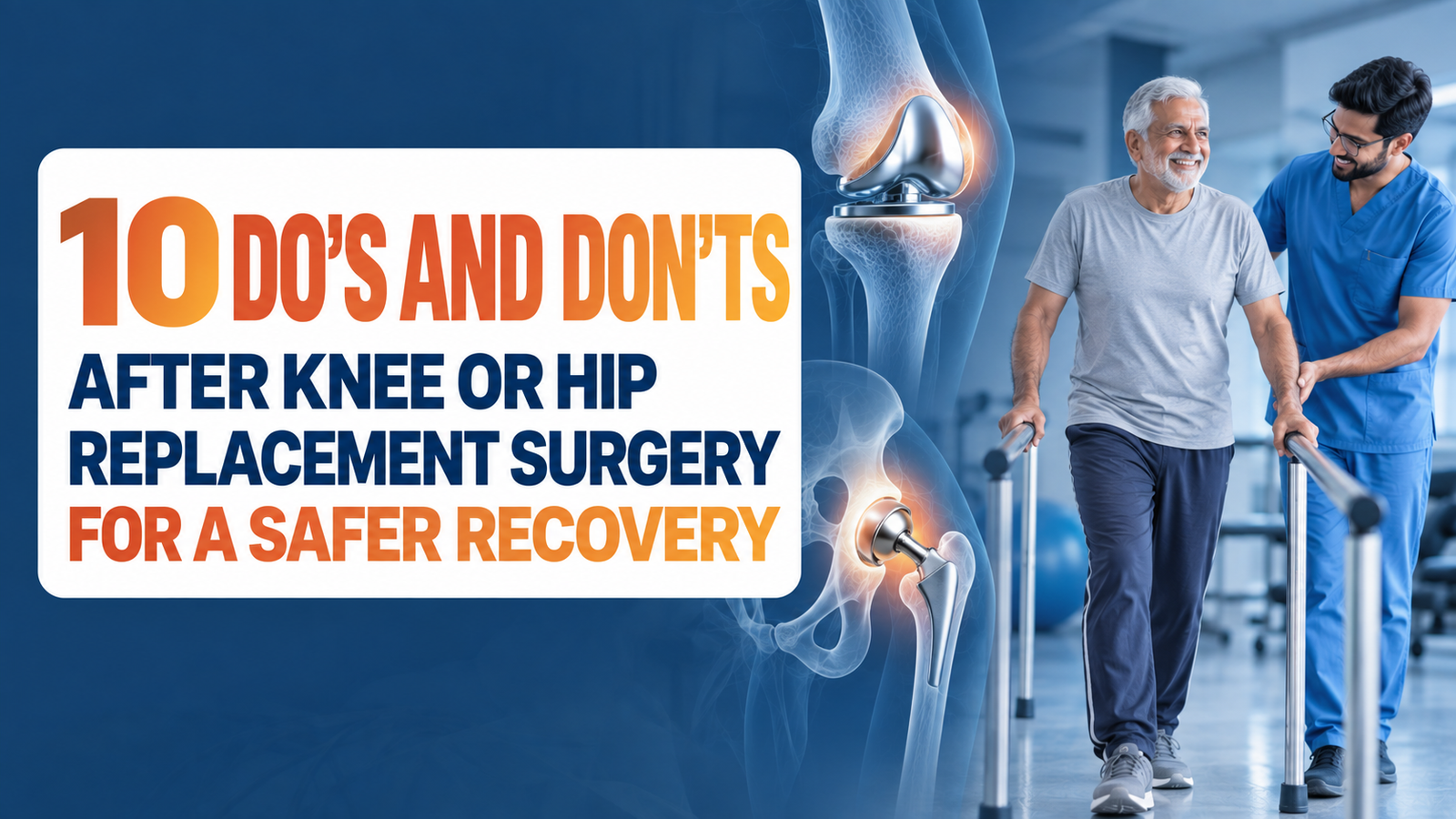
Here are 10 important do’s and don’ts after knee or hip replacement surgery.
Physiotherapy is an important part of joint replacement recovery.
Patients should perform exercises according to the programme recommended by their surgeon and physiotherapist.
Consistency is usually more useful than trying to progress too aggressively.
One patient may walk independently earlier. Another may require more time.
Age, strength, medical conditions, type of surgery and preoperative mobility can all affect recovery.
Someone else’s timeline should never become the benchmark for your own.
Remaining completely inactive because of fear can contribute to weakness and stiffness.
Patients should follow the recommended mobilisation programme, which may include short walks and prescribed exercises.
The amount of activity should increase gradually.
Feeling better does not mean the body has completed healing.
A sudden increase in walking, exercise or household activity may lead to unnecessary discomfort or swelling.
Progress should be gradual.
Patients should follow their healthcare team’s instructions regarding dressing, bathing and wound care.
Any concerning changes around the surgical wound should be reported promptly.
Patients should not apply creams, powders or home remedies to the surgical site unless specifically advised.
Certain symptoms during recovery require medical attention.
Patients should contact their healthcare team if they develop concerning or worsening symptoms, particularly those their surgeon has instructed them to watch for.
Searching online should not replace contacting the treating team when something does not feel right.
Medicines prescribed after surgery may have different purposes, including pain management and other aspects of postoperative care.
Patients should take medicines exactly as prescribed and should not independently stop, increase or substitute them.
Searching for knee replacement exercises or hip replacement exercises online produces thousands of videos.
However, an exercise suitable for one patient may not be appropriate for another.
The safest programme is one recommended according to the patient’s surgery and stage of recovery.
Recovery is not limited to the operated joint.
Adequate nutrition, hydration, sleep and management of existing medical conditions are important parts of postoperative care.
Patients should follow any specific dietary or medical advice given by their treating team.
One of the most important precautions after joint replacement surgery is understanding that feeling better and being completely recovered are not necessarily the same thing.
Driving, strenuous exercise, demanding work and other activities should be resumed according to individual medical advice.
Follow-up visits allow the surgical team to assess healing, movement, pain, function and rehabilitation progress.
Patients should continue scheduled follow-ups even when recovery appears to be going well.
Joint replacement involves more than the operation itself.
The surgeon performs the procedure, the physiotherapy team guides rehabilitation, and the patient plays an active role in following precautions and gradually rebuilding function.
Whether a patient undergoes knee replacement, hip replacement, robotic joint replacement or partial knee replacement, postoperative instructions should always be individualised.
The most important do’s and don’ts after knee or hip replacement revolve around a simple principle:
Stay active — but don’t rush. Follow rehabilitation — but don’t force it. Be patient — but don’t ignore warning signs.
A well-structured recovery programme is about helping the patient progress safely towards better movement, confidence and independence.
Medical Disclaimer: This article provides general educational information only and should not be treated as medical advice. Postoperative precautions differ according to the procedure and individual patient. Always follow the instructions provided by the treating orthopaedic surgeon and healthcare team.
Revolutionizing Joint Replacement with Robotic Precision
*This website is for providing general information only and should not be considered as medical advice or soliciting patients.
**An in-person consultation with the Doctor is adviced before practicing any remedies / recommendations mentioned on this website