

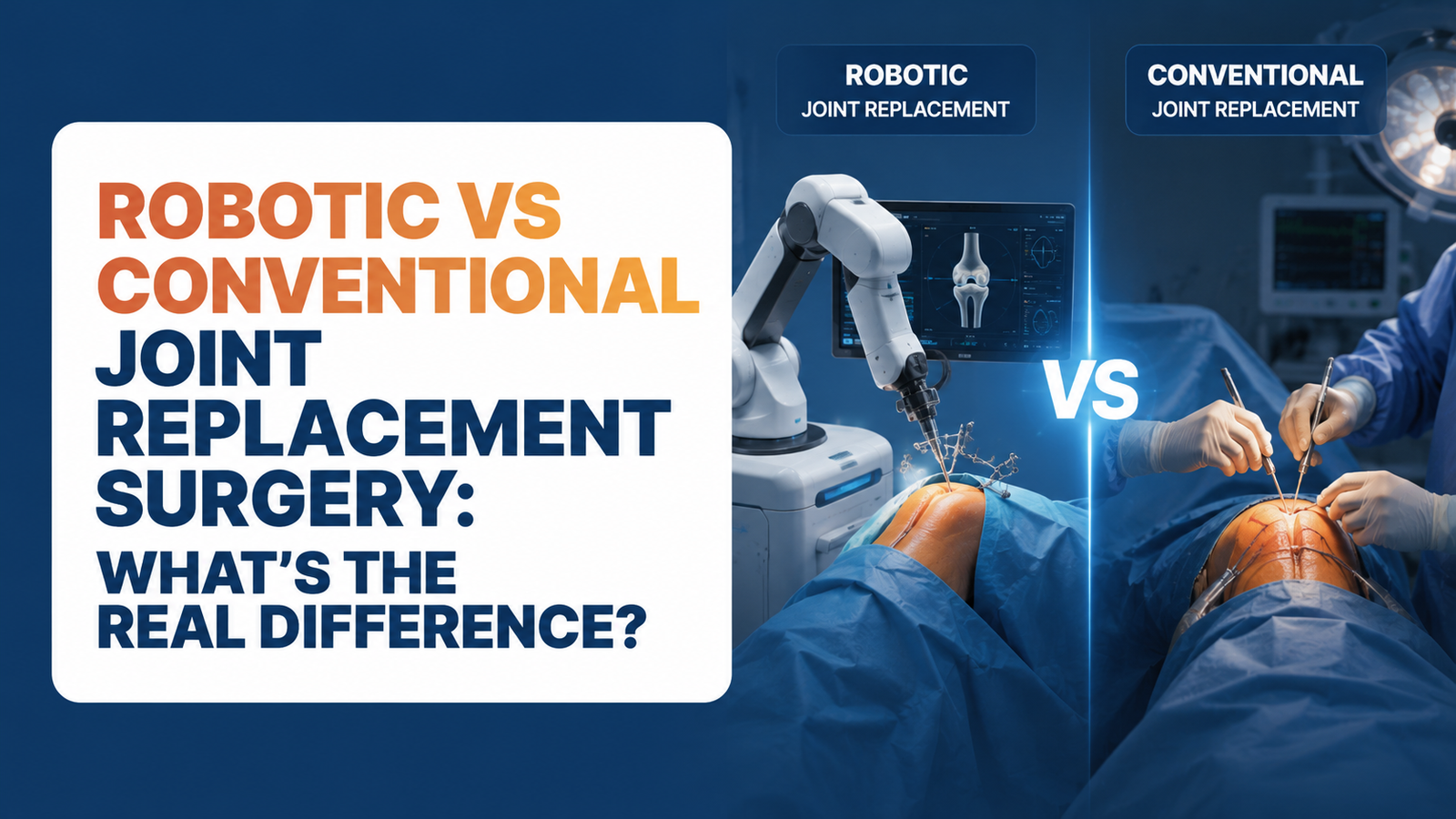
If you’ve been advised to undergo a knee or hip replacement, you’ve probably come across the term robotic joint replacement surgery. For many patients, it raises an obvious question:
The answer isn’t about choosing between a robot and a surgeon. It’s about understanding how technology can assist surgical planning and execution while keeping the surgeon firmly in control.
Let’s look at what truly separates robotic joint replacement from conventional techniques.
One of the biggest misconceptions is that a robot performs the surgery on its own. It doesn’t.
In robotic joint replacement surgery, the orthopedic surgeon performs the procedure. The robotic system acts as an advanced guidance tool, providing real-time information and precision throughout the surgery.
The expertise, judgment, and decision-making remain entirely in the hands of the surgeon.
Conventional joint replacement has been successfully performed for decades and has helped millions of patients regain mobility and reduce pain.
In a conventional procedure, surgeons use specialized instruments and anatomical landmarks to:
When performed by experienced surgeons, conventional joint replacement delivers excellent outcomes.
The key difference lies in planning and precision.
Robotic systems allow surgeons to create a highly personalized surgical plan based on the patient’s unique anatomy.
During surgery, the robotic platform provides real-time feedback that helps the surgeon execute the plan with greater accuracy.
Rather than relying solely on standard measurements, robotic technology allows for individualized decision-making.
Every knee and hip is different.
Robotic systems enable detailed pre-operative planning that takes into account:
This allows the surgery to be tailored to the specific needs of each patient rather than following a one-size-fits-all approach.
The success of a joint replacement depends significantly on how accurately the implant is positioned.
Robotic-assisted technology provides the surgeon with detailed intraoperative guidance to help achieve precise implant placement.
Accurate positioning may contribute to:
One of the most valuable advantages of robotic technology is the ability to receive real-time data during surgery.
This allows surgeons to assess and refine factors such as:
These adjustments can be made during the procedure itself.
Robotic systems are designed to assist with precise bone preparation and implant placement.
The technology helps the surgeon remain within predefined surgical parameters, increasing consistency throughout the procedure.
This level of precision is one reason why robotic-assisted joint replacement continues to gain popularity worldwide.
Many patients assume robotic surgery automatically guarantees a faster recovery. Recovery, however, depends on multiple factors, including:
Robotic technology aims to optimize surgical accuracy, which may contribute to a smoother post-operative experience, but recovery remains a highly individual process.
Not every patient requires the same surgical approach.
The best treatment option depends on:
A thorough orthopedic evaluation helps determine whether robotic-assisted surgery is appropriate for a particular patient.
Perhaps the most important thing for patients to understand is this:
Technology is only as effective as the team using it.
Robotic systems are powerful tools, but successful outcomes still depend on:
Choosing an experienced joint replacement surgeon remains one of the most important decisions a patient can make.
Conventional and robotic joint replacement surgeries share the same ultimate goal: relieving pain, restoring mobility, and improving quality of life.
The difference lies in the level of planning, personalization, and real-time precision available during the procedure.
Robotic-assisted joint replacement represents an evolution in orthopedic surgery, combining advanced technology with surgical expertise to help deliver highly accurate and individualized treatment.
For patients considering knee or hip replacement, understanding these differences can help them make more informed decisions about their treatment journey.
Revolutionizing Joint Replacement with Robotic Precision
*This website is for providing general information only and should not be considered as medical advice or soliciting patients.
**An in-person consultation with the Doctor is adviced before practicing any remedies / recommendations mentioned on this website