

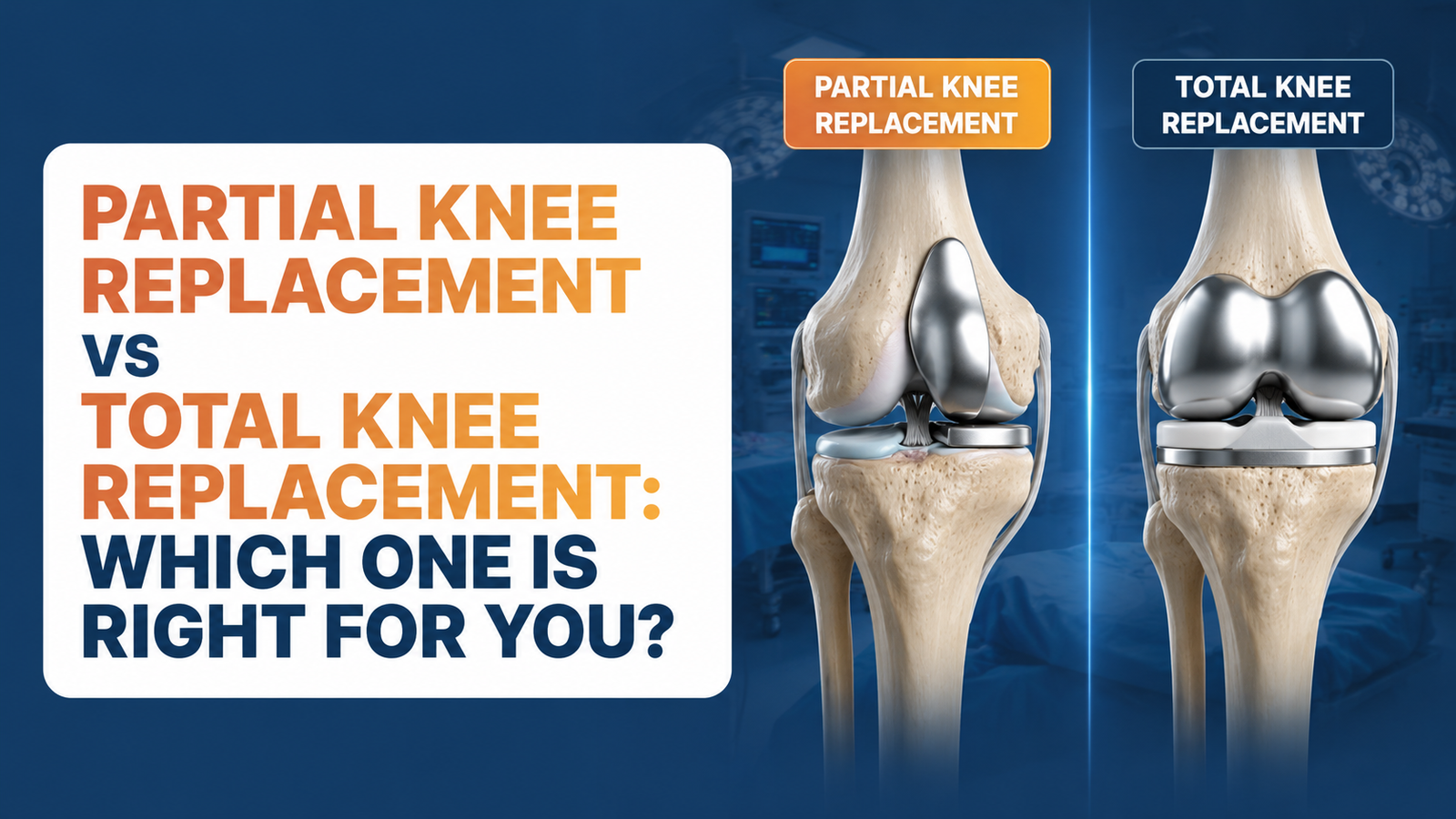
When knee arthritis begins affecting everyday activities, patients often assume that a knee replacement means replacing the entire joint.
However, that’s not always the case.
In certain patients, only a specific portion of the knee is damaged, while the remaining parts of the joint continue to function well. In such situations, a Partial Knee Replacement (PKR) may be an option.
This naturally leads to an important question:
The answer depends on the extent of arthritis, the condition of the knee joint, and careful patient selection.
Let’s explore how partial knee replacement differs from total knee replacement and why one may be more suitable than the other in specific situations.
The knee is not a single compartment.
It is made up of three main compartments:
In some patients, arthritis affects only one compartment, while the remaining compartments remain relatively healthy.
This distinction plays a major role in deciding the type of surgery.
A Total Knee Replacement (TKR) involves replacing the damaged surfaces throughout the knee joint.
It is generally recommended when:
Total knee replacement remains one of the most reliable and successful orthopedic procedures worldwide.
A Partial Knee Replacement (PKR) focuses only on the damaged compartment of the knee.
Instead of replacing the entire joint, the surgeon removes and replaces only the affected area while preserving healthy bone, cartilage, and ligaments whenever possible.
The objective is to address the diseased portion while maintaining as much of the natural knee as possible.
One of the biggest advantages of partial knee replacement is that healthy structures are retained.
This may include preservation of:
Because more of the native knee remains intact, some patients report that the knee feels more natural after recovery.
When performed in appropriately selected patients, partial knee replacement may offer several benefits.
Since only one compartment is treated, less bone and tissue are removed compared to a total knee replacement.
Retaining key ligaments and healthy structures can help maintain more natural knee function.
Many patients experience quicker early recovery and return to daily activities sooner.
Because the procedure is generally less extensive, blood loss may be lower compared to total knee replacement.
Some patients describe their knee as feeling more like a natural joint rather than an artificial one.
While the benefits can be appealing, partial knee replacement is not appropriate for everyone. A total knee replacement may be the better option when:
This is why careful evaluation is essential before making a treatment decision.
Choosing between partial and total knee replacement is based on several factors, including:
The goal is not to perform the smaller surgery whenever possible.
The goal is to perform the most appropriate surgery for long-term success.
Robotic-assisted knee replacement technology has enhanced precision in both partial and total knee replacement procedures.
Robotic systems can assist with:
This allows the surgeon to tailor the procedure to the patient’s unique anatomy.
Many patients ask whether a total knee replacement lasts longer than a partial knee replacement.
The answer depends on multiple factors, including:
Both procedures can provide excellent outcomes when the right operation is performed for the right patient.
Partial knee replacement is not a smaller version of total knee replacement—it is a different procedure designed for a specific group of patients.
When arthritis is limited to a single compartment of the knee, preserving healthy tissue while treating the damaged area can offer meaningful advantages.
However, success depends heavily on accurate diagnosis, careful patient selection, and precise surgical execution.
The best knee replacement surgery is not necessarily the least invasive one. It is the procedure that most effectively restores function, relieves pain, and supports long-term joint health for that individual patient.
Revolutionizing Joint Replacement with Robotic Precision
*This website is for providing general information only and should not be considered as medical advice or soliciting patients.
**An in-person consultation with the Doctor is adviced before practicing any remedies / recommendations mentioned on this website