

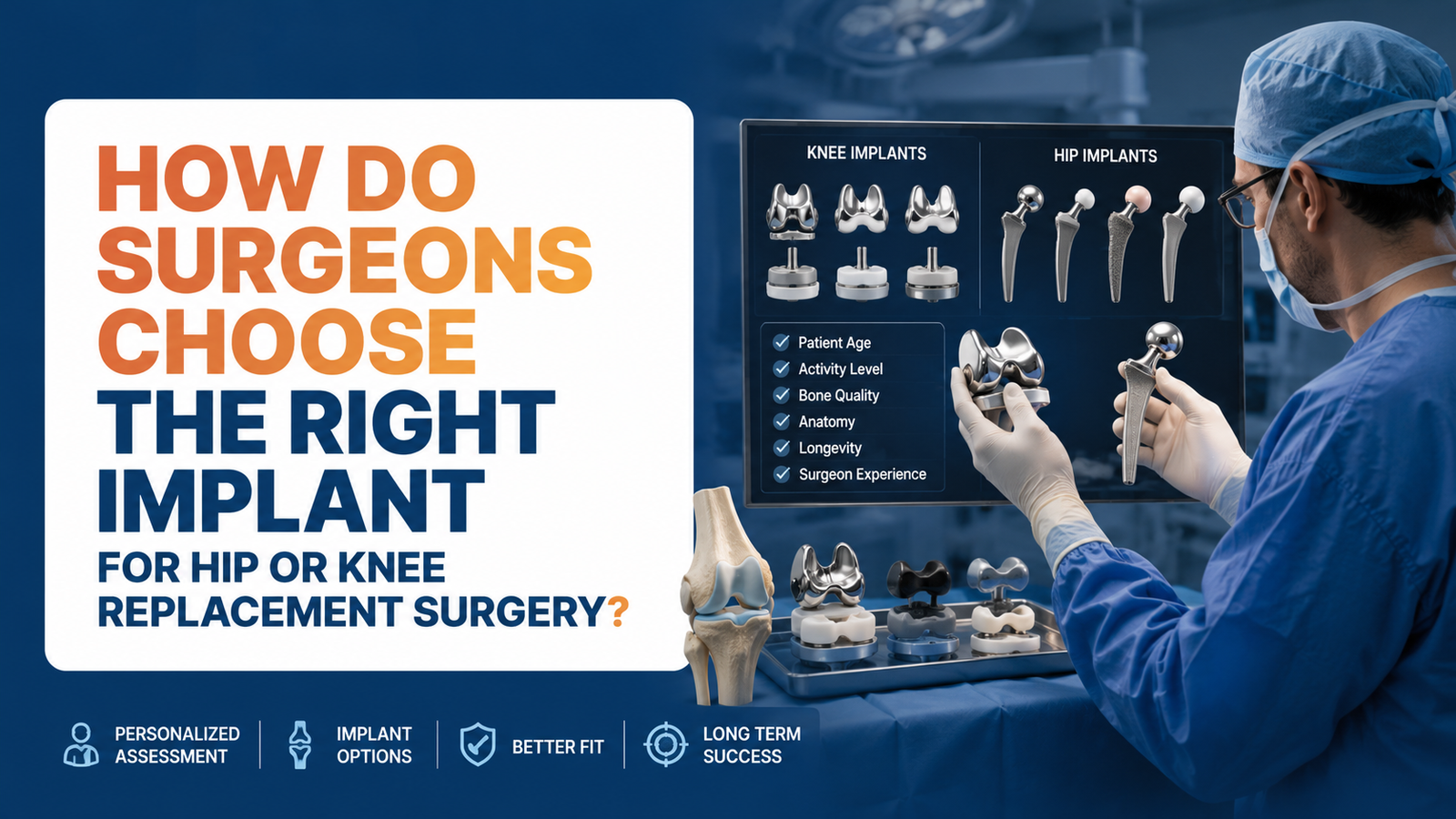
One of the first questions many patients ask before a hip or knee replacement surgery is: “Which implant will you use?”
It’s a reasonable question. After all, the implant is the part that will replace the damaged joint and help restore movement for years to come.
However, many patients are surprised to learn that choosing an implant is not as simple as selecting a particular brand or the latest model available in the market.
In reality, implant selection is a carefully planned medical decision based on a combination of science, anatomy, biomechanics, and patient-specific factors.
The best implant is not necessarily the newest or the most expensive one. It is the implant that best suits the individual patient.
In a hip or knee replacement surgery, the damaged portions of the joint are removed and replaced with specially designed artificial components called implants.
These implants are engineered to:
Modern implants are developed using advanced materials and decades of orthopedic research.
Every patient is unique.
Differences in:
mean that the same implant may not be ideal for everyone.
The objective is to match the implant to the patient’s anatomy and functional needs rather than forcing every patient into a standard solution.
Perhaps the most important consideration is anatomy.
Surgeons carefully evaluate:
The implant must fit accurately to achieve proper function and stability.
Modern imaging and surgical planning help surgeons determine the most appropriate implant dimensions before surgery begins.
Not all arthritis affects joints in the same way.
The extent of:
helps guide implant selection.
Different clinical situations may require different implant designs to restore optimal function.
The expectations of a 50-year-old active professional may differ significantly from those of an 80-year-old patient seeking pain relief for routine daily activities.
Surgeons consider:
when selecting implants.
The goal is to support the patient’s desired level of activity while maintaining durability and reliability.
Strong, healthy bone provides an excellent foundation for implant fixation. However, bone quality can vary considerably between patients.
Factors such as osteoporosis or previous injuries may influence the choice of:
Proper implant selection helps optimize long-term stability.
Modern orthopedic surgery increasingly relies on advanced planning tools. Robotic-assisted joint replacement systems allow surgeons to:
This technology helps ensure that implant selection and placement are tailored to each patient’s unique anatomy.
Many patients spend considerable time researching implant brands online.
While implant quality is certainly important, successful outcomes depend on much more than the brand name.
Key factors include:
Even the most advanced implant performs best when it is selected appropriately and positioned accurately.
Although detailed planning occurs before surgery, final decisions are often verified during the procedure itself.
The surgeon assesses:
This ensures that the selected implant performs optimally within the patient’s anatomy.
Robotic systems do not choose implants independently.
However, they provide highly detailed information that assists surgeons in making more informed decisions.
This may help improve:
Technology serves as a tool that enhances precision while keeping the surgeon firmly in control.
Choosing the right implant for a hip or knee replacement is a personalized process that extends far beyond selecting a brand name.
The decision is based on careful evaluation of anatomy, joint condition, bone quality, activity level, and long-term goals.
Modern orthopedic surgery combines clinical expertise, advanced imaging, robotic technology, and individualized planning to help ensure that every patient receives the implant best suited to their needs.
Ultimately, the right implant is the one that allows the surgeon to restore stability, function, comfort, and confidence in movement for years to come.
Revolutionizing Joint Replacement with Robotic Precision
*This website is for providing general information only and should not be considered as medical advice or soliciting patients.
**An in-person consultation with the Doctor is adviced before practicing any remedies / recommendations mentioned on this website