
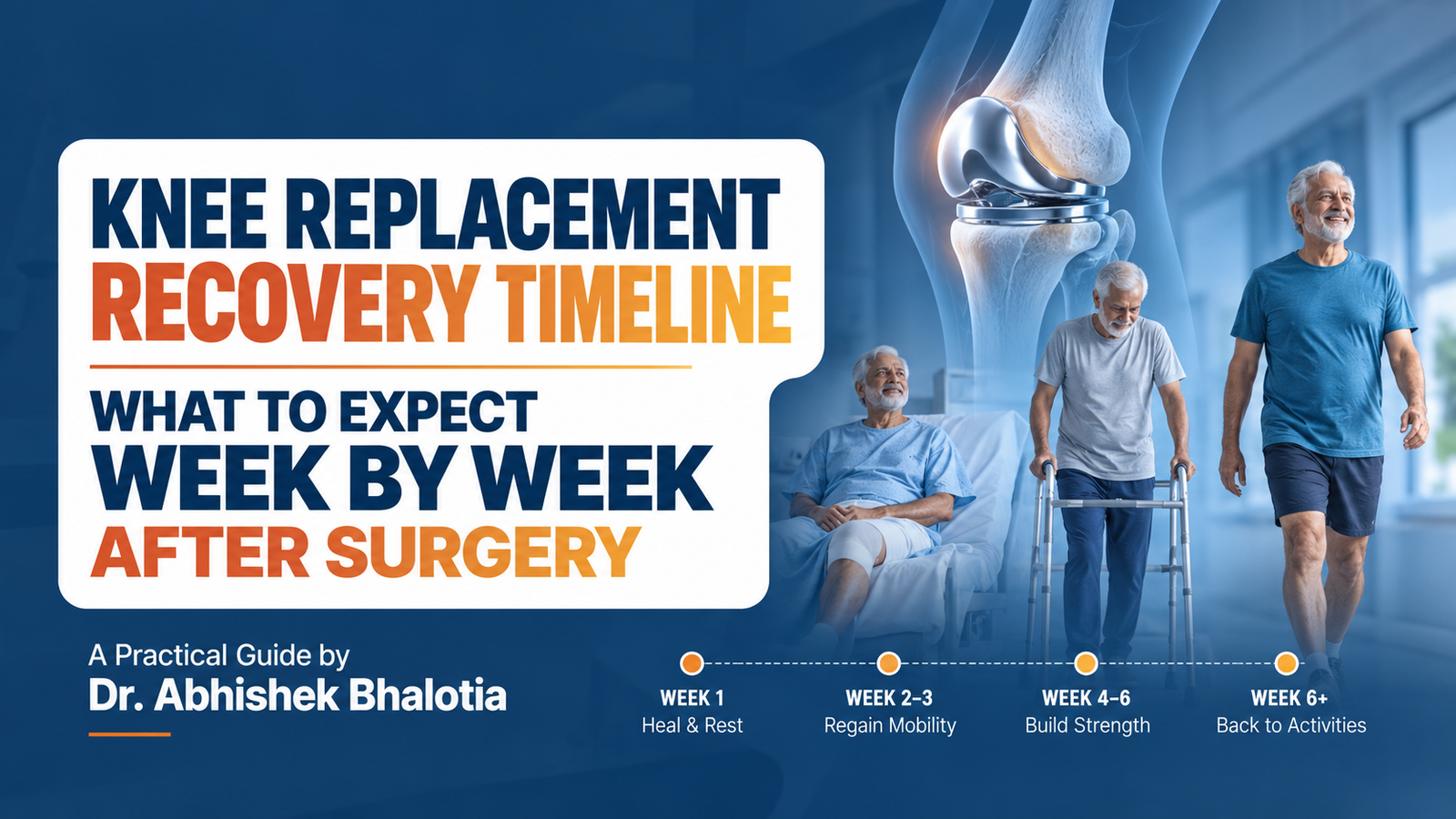
Knee replacement surgery is only one part of the treatment journey. What happens after surgery — rehabilitation, physiotherapy, walking, strengthening and gradually returning to everyday activities — plays an equally important role.
One of the most common questions patients ask before surgery is, “How long does knee replacement recovery take?”
There is no single recovery timeline that applies to everyone. Age, overall health, muscle strength, type of knee replacement, surgical approach and commitment to rehabilitation can all influence recovery after knee replacement surgery.
Understanding the usual knee replacement recovery timeline can, however, help patients prepare better.
Recovery usually begins soon after surgery under the guidance of the treating surgical and rehabilitation team.
Depending on the patient’s condition, early recovery may include:
Early mobilisation is generally encouraged when medically appropriate because prolonged inactivity can contribute to stiffness and muscle weakness.
During the first week, the primary focus is not on walking long distances. It is on safe movement and gradual improvement.
Patients may work on:
Pain, swelling and stiffness can occur during the early stages of knee replacement recovery. These should be discussed with the treating team, particularly if symptoms are severe, unusual or worsening.
As healing progresses, many patients gradually become more comfortable with everyday movement.
Physiotherapy after knee replacement commonly focuses on improving:
Patients may progressively become more independent in activities around the home. The requirement for walking aids varies from person to person and should be determined by the physiotherapist or surgeon.
A common mistake during this period is comparing recovery with another patient. Two people undergoing similar surgery can still have very different knee replacement recovery times.
During this stage, patients may notice improvements in mobility, strength and confidence.
Depending on individual progress, rehabilitation may include:
Patients should not interpret feeling better as a reason to stop physiotherapy prematurely. Recovery continues even after basic independence returns.
By this stage, the emphasis often moves from basic mobility towards improving endurance, strength and quality of movement.
Many patients want to know, “When can I walk normally after knee replacement?”
There is no universal date. Walking without support depends on balance, muscle control, confidence, pain levels and the individual’s overall recovery.
Patients should follow their rehabilitation team’s assessment rather than an arbitrary timeline found online.
It is important to understand that recovery after knee replacement is a process, not an event.
Even when a patient has returned to many everyday activities, improvements in strength, movement, confidence and function may continue for several months.
Patients should continue appropriate exercises and follow-up appointments as recommended.
Several factors can affect recovery, including:
Modern approaches, including robotic knee replacement and muscle-sparing surgical philosophies where appropriate, may form part of an individualised treatment strategy. However, technology alone does not determine recovery. Surgical planning, execution, rehabilitation and patient participation all matter.
Some patients progress quickly. Others require more time.
The objective of rehabilitation is not to compete with somebody else’s recovery timeline. It is to help each patient progress safely towards better movement and independence.
As Dr. Abhishek Bhalotia emphasises in his approach to joint replacement care, surgery may address the damaged joint, but structured rehabilitation and patient participation are essential parts of the journey back to movement.
The knee replacement recovery timeline varies for every patient. Recovery typically progresses from assisted mobilisation to improving flexibility, strength, balance and everyday independence.
Patients considering or recovering from knee replacement should discuss their individual recovery milestones with their orthopaedic surgeon and physiotherapy team rather than relying on a fixed online timeline.
Medical Disclaimer: This article is intended for general educational purposes only and should not be considered medical advice. Recovery varies between individuals. Patients should consult their treating orthopaedic surgeon or healthcare professional for personalised recommendations.
Revolutionizing Joint Replacement with Robotic Precision
*This website is for providing general information only and should not be considered as medical advice or soliciting patients.
**An in-person consultation with the Doctor is adviced before practicing any remedies / recommendations mentioned on this website