
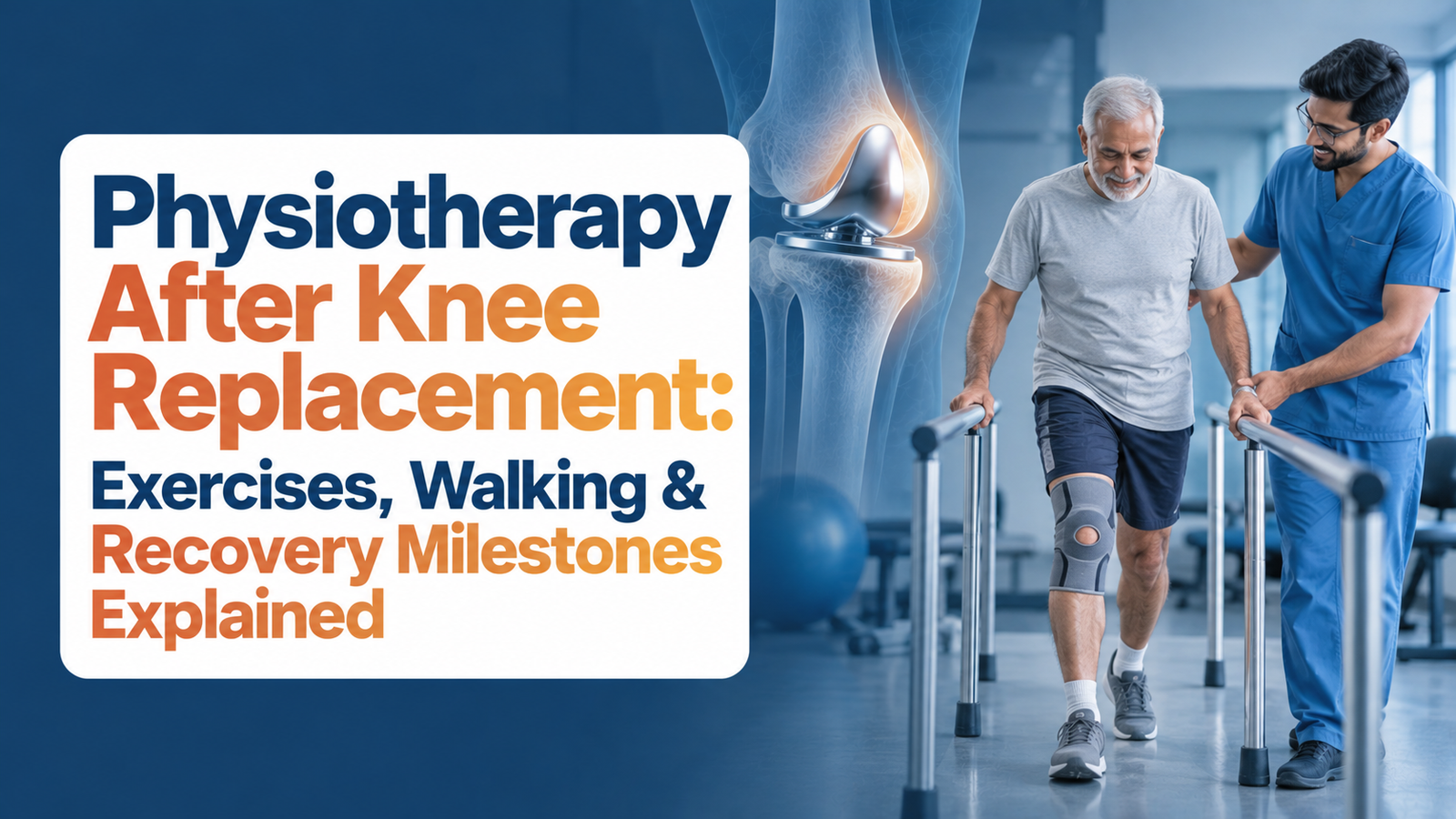
A successful knee replacement journey does not end when the surgery is completed.
Recovery requires the patient, surgeon and physiotherapy team to work together towards a common objective — restoring safe movement and improving functional independence.
This is why physiotherapy after knee replacement is an important component of postoperative rehabilitation.
Before knee replacement, patients with advanced arthritis may have spent months or years walking differently because of pain.
As activity reduces, muscles can become weaker and the knee may become stiff.
Surgery addresses the damaged joint surfaces, but the body still needs rehabilitation afterwards.
Knee replacement physiotherapy commonly aims to improve:
Rehabilitation should be tailored to the individual patient.
When medically appropriate, movement generally begins relatively early.
Initial exercises may be simple and supervised. The objective is to activate muscles and begin restoring movement without unnecessarily overloading the recovering joint.
Depending on medical advice, early rehabilitation may involve ankle movements, quadriceps activation and gentle knee movement.
Patients should perform only exercises recommended by their healthcare team.
Walking after knee replacement is an important part of rehabilitation, but more walking is not automatically better.
Initially, patients may require a walker or another walking aid.
Physiotherapy focuses not only on distance but also on the quality and safety of walking.
Patients may work on:
Walking aids should be reduced only when it is considered safe.
Restoring functional knee movement is an important rehabilitation goal.
Physiotherapists may prescribe specific exercises after knee replacement to progressively improve bending and straightening.
Patients sometimes become overly focused on achieving a particular degree of knee bending within a specific number of days.
Recovery should instead be assessed individually. Forcing exercises beyond recommended limits can be counterproductive.
Muscle strength is important for standing, walking, climbing stairs and maintaining balance.
Rehabilitation commonly works on muscles around the knee and hip, including the quadriceps.
Exercises are usually progressed according to the patient’s strength, pain, balance and stage of recovery.
As patients improve, physiotherapy after knee replacement surgery becomes increasingly functional.
This may involve practising:
The objective is to translate improvements in strength and movement into real-world independence.
Patients should avoid turning rehabilitation into a competition.
Common mistakes can include:
The correct balance between activity and recovery should be determined with the treating team.
There is no universal duration.
The length and intensity of knee replacement rehabilitation depend on the patient’s preoperative condition, type of surgery, strength, mobility and progress.
Some patients may achieve functional milestones earlier, while others require longer rehabilitation.
The important question is not, “How quickly can physiotherapy be stopped?”
It is, “Has the patient regained the movement, strength and confidence required for everyday life?”
Modern surgical techniques and technologies, including robotic knee replacement, can assist surgeons with aspects of planning and execution. However, rehabilitation remains a separate and important component of recovery.
A technically well-performed operation still requires appropriate postoperative care and patient participation.
Physiotherapy after knee replacement is not merely a set of exercises. It is a structured process aimed at restoring movement, strength, balance, walking ability and confidence.
Patients should follow an individualised rehabilitation programme prescribed by their surgeon and physiotherapist rather than copying exercises or recovery timelines from other patients.
Medical Disclaimer: This article is for general educational purposes only. Exercises and rehabilitation requirements vary between patients. Always follow the advice of the treating orthopaedic surgeon and qualified physiotherapist.
Revolutionizing Joint Replacement with Robotic Precision
*This website is for providing general information only and should not be considered as medical advice or soliciting patients.
**An in-person consultation with the Doctor is adviced before practicing any remedies / recommendations mentioned on this website