

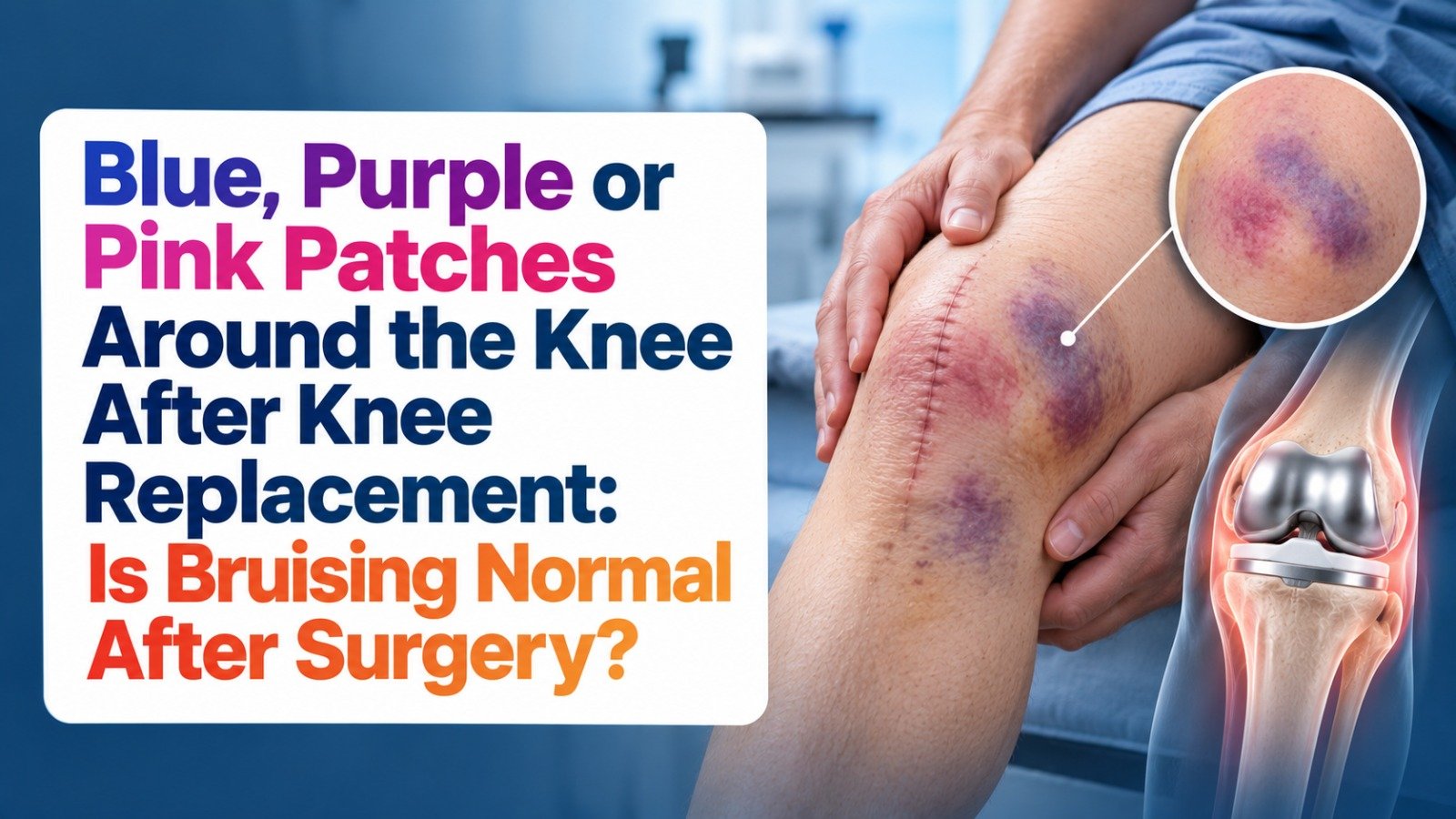
Patients recovering from knee replacement sometimes notice something that immediately causes concern:
Blue, purple, pink, yellow or dark patches around the operated knee.
This naturally raises questions.
“Is this bruising normal?”
“Is there internal bleeding?”
“Could this be an infection?”
Skin discolouration and bruising after knee replacement can occur during postoperative recovery. However, patients should understand why it happens and, more importantly, which changes require medical evaluation.
Knee replacement is a major surgical procedure involving tissues around the joint.
Small amounts of blood can collect beneath the skin during the healing process. As this blood is gradually broken down and absorbed by the body, the colour of the skin can change.
A bruise may appear:
The appearance can vary considerably between patients.
Yes.
Patients sometimes become surprised when bruising appears away from the actual surgical incision.
Discolouration may extend towards:
Gravity and movement of postoperative fluid through the tissues can contribute to changes appearing lower down the leg.
This does not automatically mean something has gone wrong.
The extent of bruising after knee surgery varies.
Factors may include:
This is why comparing one patient’s operated knee with another patient’s knee is rarely helpful.
This requires more careful interpretation.
Some colour change can occur during healing. However, increasing redness — particularly around the surgical wound — may sometimes indicate a problem.
Patients should pay attention to associated symptoms.
Contact the treating team if redness is:
Patients should not attempt to diagnose a blood clot based only on skin colour.
A possible blood clot after knee replacement may be associated with symptoms such as:
Sudden breathlessness or chest pain requires urgent medical attention.
Patients should avoid aggressively massaging, applying home remedies or using medications on the operated leg unless advised by their healthcare team.
Postoperative tissues require time to heal.
If a patient is concerned about bruising, sending a photograph to the treating team or undergoing clinical evaluation may be more appropriate than experimenting with remedies.
There is no exact timeline.
The colour and extent of bruising may evolve during recovery before gradually resolving.
Some patients experience very little bruising, while others develop considerable discolouration.
Again, the pattern matters more than comparing the number of days with another patient.
During recovery after knee replacement, patients should observe:
Photographs taken periodically may also help patients and their surgical team observe how the appearance is changing.
Seek medical advice if skin changes are accompanied by:
Blue, purple, pink or yellow patches around the knee can sometimes be part of the body’s normal healing response after knee replacement.
But colour alone should never be used to decide whether everything is normal.
Dr. Abhishek Bhalotia advises patients to look at the complete picture – pain, swelling, wound appearance, temperature and overall recovery – and communicate with their treating team whenever something appears unusual.
Medical Disclaimer: This article provides general educational information only. Skin discolouration following surgery can have different causes. Patients should contact their treating surgeon for personalised assessment, particularly if symptoms are worsening or associated with other warning signs.

Revolutionizing Joint Replacement with Robotic Precision
*This website is for providing general information only and should not be considered as medical advice or soliciting patients.
**An in-person consultation with the Doctor is adviced before practicing any remedies / recommendations mentioned on this website