Robotic technology has become increasingly important in modern knee replacement surgery.
One system patients may encounter while researching robotic knee replacement surgery is the CORI Surgical System.
But what exactly is CORI?
Does a robot perform the knee replacement?
Does it require a CT scan?
And how does it assist the surgeon?
Here is a simple explanation.
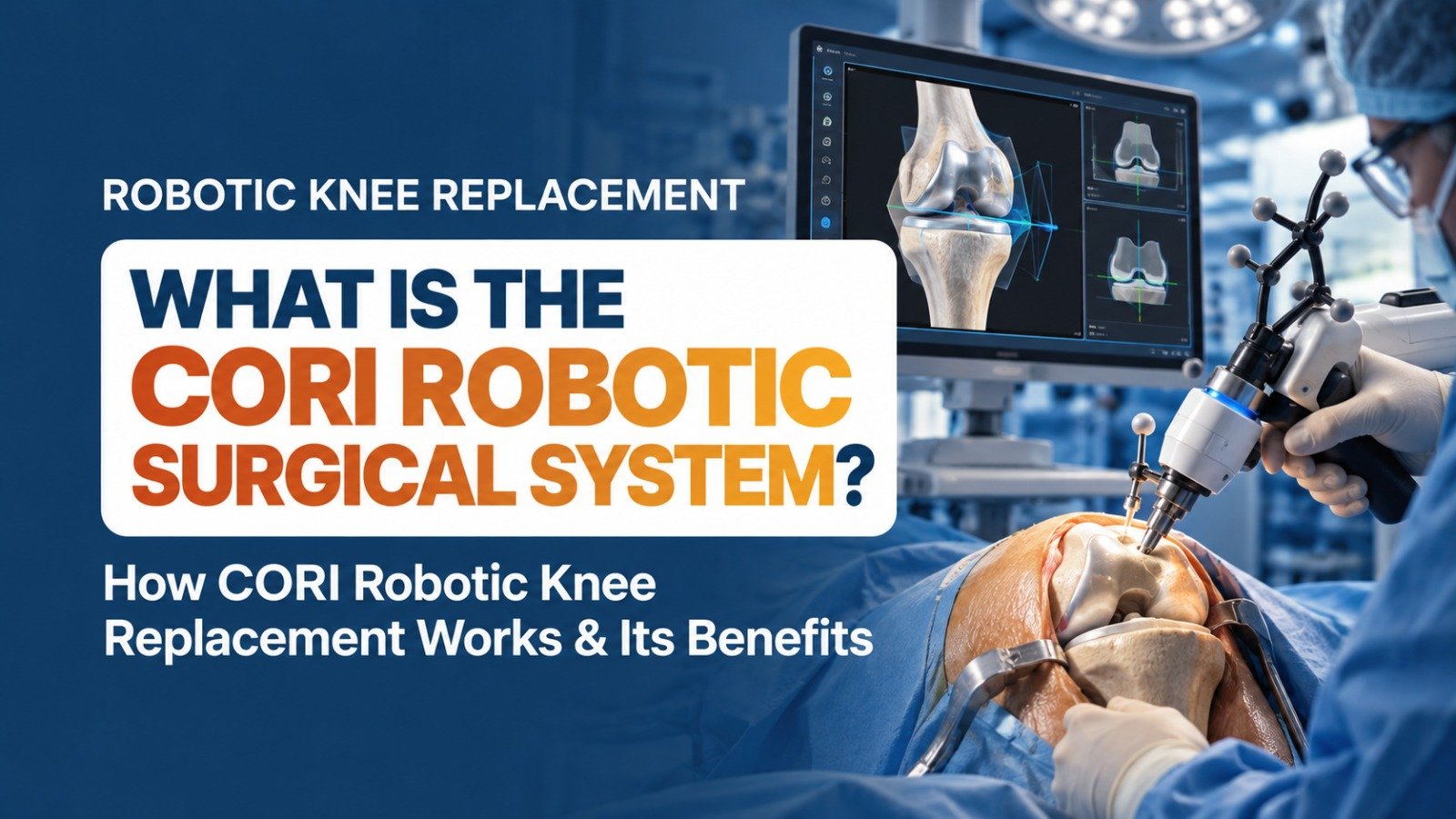
The CORI Surgical System is a handheld robotic-assisted platform developed by Smith+Nephew for joint replacement applications.
An important distinction needs to be made immediately:
CORI does not independently perform knee replacement surgery.
The surgeon remains in control of the procedure.
The technology assists the surgeon with digital mapping, planning, assessment and precision during specific stages of the operation.
The process can broadly be understood in four stages.
During surgery, the system can create a three-dimensional representation of the patient’s knee anatomy.
This is performed using image-free registration, meaning the CORI workflow can build its surgical model without requiring a preoperative CT or MRI specifically for that mapping process.
The information gathered helps the surgeon develop and refine an individualised surgical plan.
Rather than treating every knee identically, planning can consider the patient’s anatomy and deformity.
Knee replacement is not simply about removing damaged bone.
The reconstructed knee also needs appropriate alignment and soft-tissue balance.
CORI provides real-time information that can assist the surgeon in assessing these factors during surgery.
The surgeon controls a handheld robotic instrument that assists with precise bone preparation according to the surgical plan.
Again, the key word is assists.
The surgeon remains responsible for clinical decisions and execution.
Yes.
The CORI platform has applications in both:
Its applications and implant compatibility vary according to regulatory approvals, software and individual clinical requirements.
One notable feature of CORI is its image-free smart mapping capability.
The system can generate the required three-dimensional joint model intra-operatively rather than depending on a preoperative CT or MRI for its knee mapping workflow.
Patients should nevertheless undergo whatever imaging their surgeon considers clinically necessary for diagnosis and surgical planning.
Depending on the procedure and patient, robotic assistance can support:
These are technical advantages of the platform.
They should not be confused with guaranteed patient outcomes.
This is perhaps the most important question.
No robotic system can independently guarantee a successful Joint Replacement.
Technology is only one component of the overall process.
Outcome depends on multiple factors, including:
Dr. Abhishek Bhalotia’s approach to robotic joint replacement therefore places the surgeon – not the machine – at the centre of decision-making.
Not necessarily.
The appropriate procedure depends on the individual knee.
Some patients may require Total Knee Replacement.
Others with arthritis isolated to one compartment may potentially be candidates for Partial Knee Replacement.
Some may not require replacement at all and may still benefit from Joint Preservation strategies.
Technology should therefore support the correct treatment – not determine it.
Before deciding, patients can ask:
The CORI Robotic Surgical System combines intra-operative mapping, personalised planning, real-time assessment and surgeon-controlled handheld robotic bone preparation to assist in knee replacement procedures.
But perhaps the most important fact for patients to remember is:
The robot provides precision. The surgeon provides judgment.
Modern Robotic Joint Replacement works best when advanced technology is combined with appropriate patient selection, detailed planning, surgical experience and structured rehabilitation.
Medical Disclaimer: This article is intended for general educational purposes only and should not be considered medical advice or a recommendation for a particular device or surgical procedure. Suitability for robotic joint replacement should be determined after an in-person clinical assessment.
Revolutionizing Joint Replacement with Robotic Precision
*This website is for providing general information only and should not be considered as medical advice or soliciting patients.
**An in-person consultation with the Doctor is adviced before practicing any remedies / recommendations mentioned on this website