

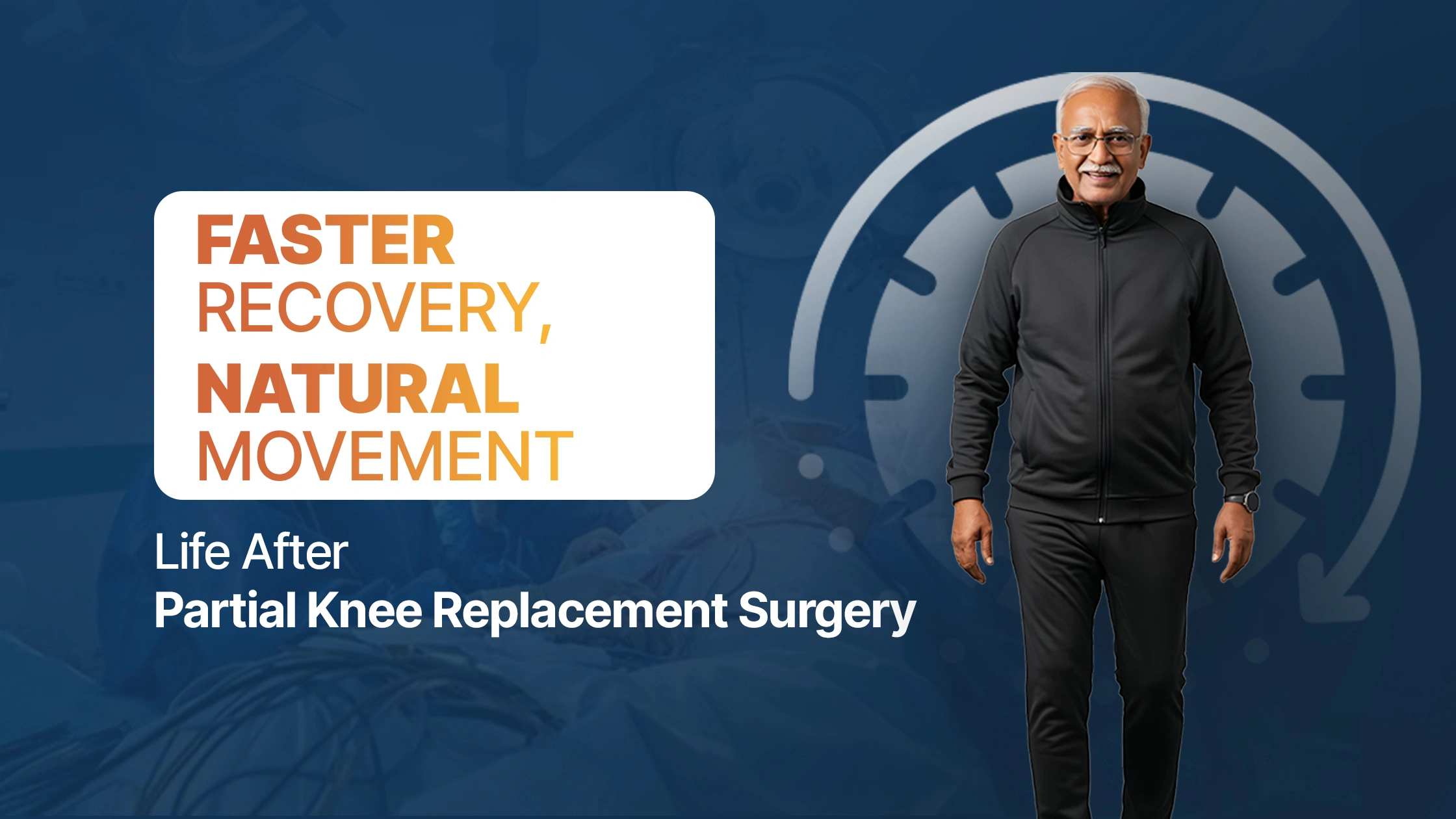
One of the biggest fears patients have before knee surgery is not the operation itself, but life after surgery.
Questions like “How long will recovery take?”, “Will I walk normally again?”, and “Will my knee feel artificial?” are extremely common.
For patients who qualify, Partial Knee Replacement Surgery often answers these concerns far better than expected.
According to Dr. Abhishek Bhalotia, who specialises in advanced knee replacement techniques, “Partial knee replacement focuses on preserving what is healthy in the knee. That is why recovery feels faster and movement feels more natural for the right patient.”
This blog takes a closer look at what life is like after partial knee replacement, how recovery typically progresses, and why many patients experience a smoother return to daily activities.
Partial knee replacement is fundamentally different from total knee replacement because less of the knee is disturbed during surgery.
Key reasons recovery is faster:
Because the body has less to heal, patients often regain confidence earlier.

Recovery varies from person to person, but most patients follow a similar pattern.
Early Phase (First Few Days)
Many patients are surprised by how quickly they are able to move.
This is where partial knee replacement truly stands out.
Most patients experience:
Physiotherapy during this phase focuses more on mobility and confidence, rather than rebuilding muscle strength.
By this stage:
Patients often report that the knee feels “less operated” and more like their own.
With consistent rehabilitation and guidance:
The preserved ligaments and natural knee mechanics contribute to long-term comfort.
One of the biggest advantages of partial knee replacement is how the knee feels during movement.
Reasons for more natural movement:
Patients often say they “forget” about the knee during daily activities — a feeling that matters greatly in long-term satisfaction
Most patients can safely resume:
High-impact sports may still be restricted, but daily life becomes significantly easier.
Not every knee is suitable for partial replacement. Recovery outcomes depend heavily on choosing the right patient.
Dr. Abhishek Bhalotia follows a structured assessment that includes:
When partial knee replacement is done for the right indication, recovery is smoother and outcomes are more predictable.
Life after partial knee replacement is often described as lighter, easier, and more natural by patients who qualify for the procedure.
The surgery works not because it does more —
but because it respects what is still healthy.
As Dr. Abhishek Bhalotia often explains, “Preserving normal anatomy is the key to faster recovery and natural movement.”
For patients with localized knee arthritis, partial knee replacement can be a life-changing step toward pain-free movement and faster independence.
Revolutionizing Joint Replacement with Robotic Precision
*This website is for providing general information only and should not be considered as medical advice or soliciting patients.
**An in-person consultation with the Doctor is adviced before practicing any remedies / recommendations mentioned on this website