

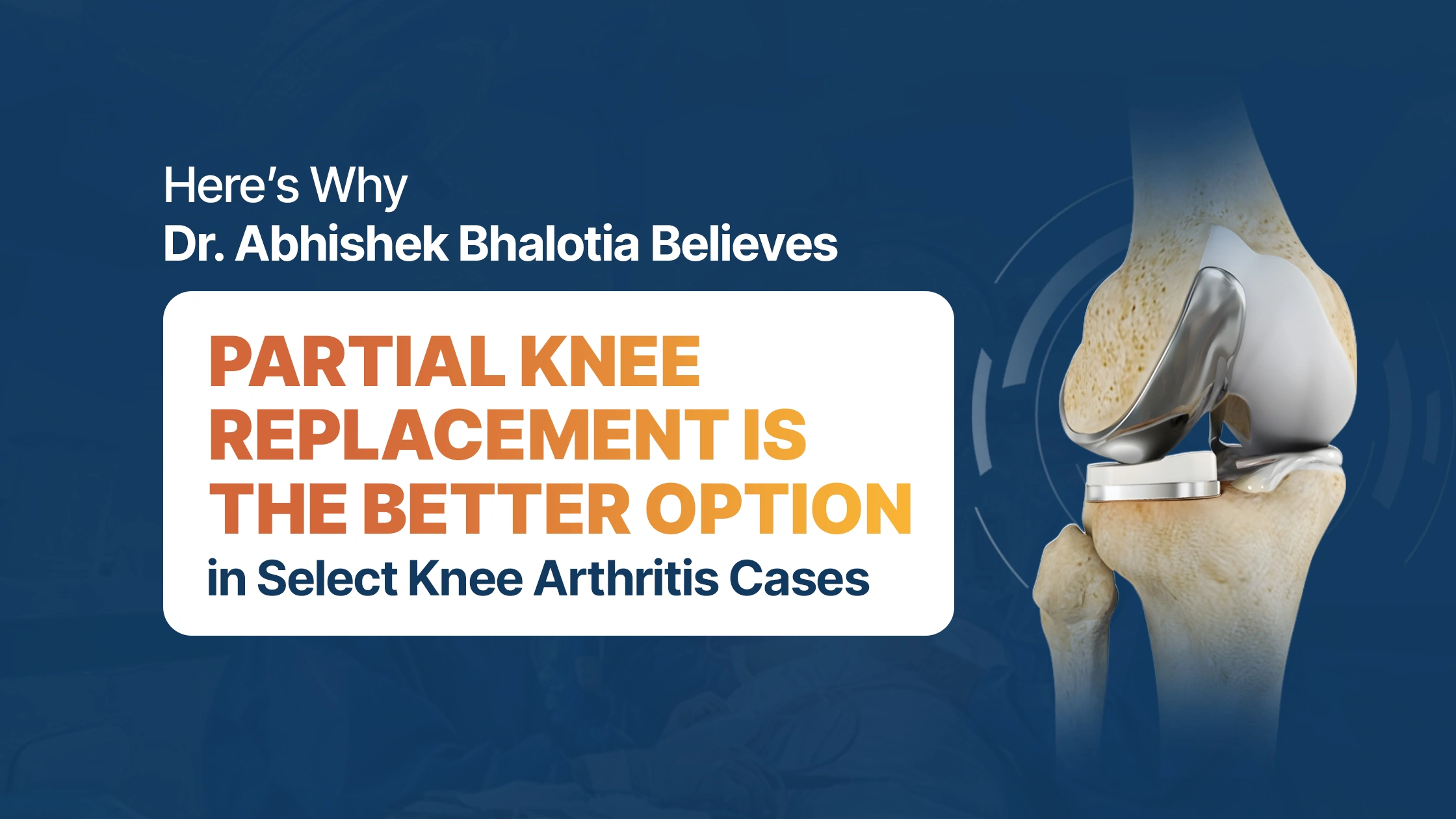
When patients hear the words knee replacement, most immediately assume that the entire knee joint must be replaced. This belief has been shaped over decades, largely because Total Knee Replacement has been the most commonly discussed surgical option. However, modern orthopaedics has evolved, and so has the way knee arthritis is treated.
According to Dr. Abhishek Bhalotia, Partial Knee Replacement is often a better, smarter, and more patient-friendly option in carefully selected cases of knee arthritis.
This perspective is not about promoting a particular surgery, but about matching the extent of surgery with the extent of disease.
One of the most important points Dr. Bhalotia highlights is that knee arthritis does not affect every knee in the same way.
The knee has three compartments:
In many patients, arthritis is limited to just one compartment, most commonly the inner side of the knee. In such situations, replacing the entire knee joint may not always be necessary.
This is where Partial Knee Replacement (PKR) becomes a strong and logical option.

Dr. Abhishek Bhalotia believes that doing more surgery than required does not automatically lead to better results.
His reasoning is simple:
Partial Knee Replacement allows surgeons to replace only the diseased compartment, while leaving the rest of the knee untouched.
When recommended for the right patient, Partial Knee Replacement offers several advantages:
Patients often describe the knee as feeling less artificial and more like their own.
Dr. Bhalotia is very clear that Partial Knee Replacement is not suitable for everyone.
He typically considers it when:
A thorough clinical examination and imaging assessment are essential before making this decision.
One common misconception Dr. Bhalotia often addresses is that partial knee replacement is a lesser or temporary solution.
In reality:
Partial knee replacement is not about avoiding surgery —
it is about avoiding unnecessary surgery.
Dr. Bhalotia also strongly believes in being balanced and honest.
He does not recommend partial knee replacement when:
In such cases, Total Knee Replacement provides better long-term relief and predictability.
This balanced approach is why many patients seek him for second opinions, especially when confused between different surgical recommendations.
Dr. Abhishek Bhalotia’s opinion is rooted in a simple philosophy:
“The goal of knee replacement is not to replace the knee —
it is to restore function, confidence, and quality of life.”
By preserving healthy structures whenever possible, Partial Knee Replacement aligns well with this philosophy.
Patients today often consult multiple doctors, search online, and hear conflicting advice. This can lead to confusion, anxiety, and delayed decision-making.
Dr. Bhalotia’s approach helps patients:
Partial Knee Replacement is not a universal solution —
but in select knee arthritis cases, it can be the better option.
By carefully evaluating the knee and recommending surgery only when appropriate, Dr. Abhishek Bhalotia ensures that:
For patients with localized knee arthritis, partial knee replacement can offer excellent outcomes without unnecessary surgical trauma.

Revolutionizing Joint Replacement with Robotic Precision
*This website is for providing general information only and should not be considered as medical advice or soliciting patients.
**An in-person consultation with the Doctor is adviced before practicing any remedies / recommendations mentioned on this website