

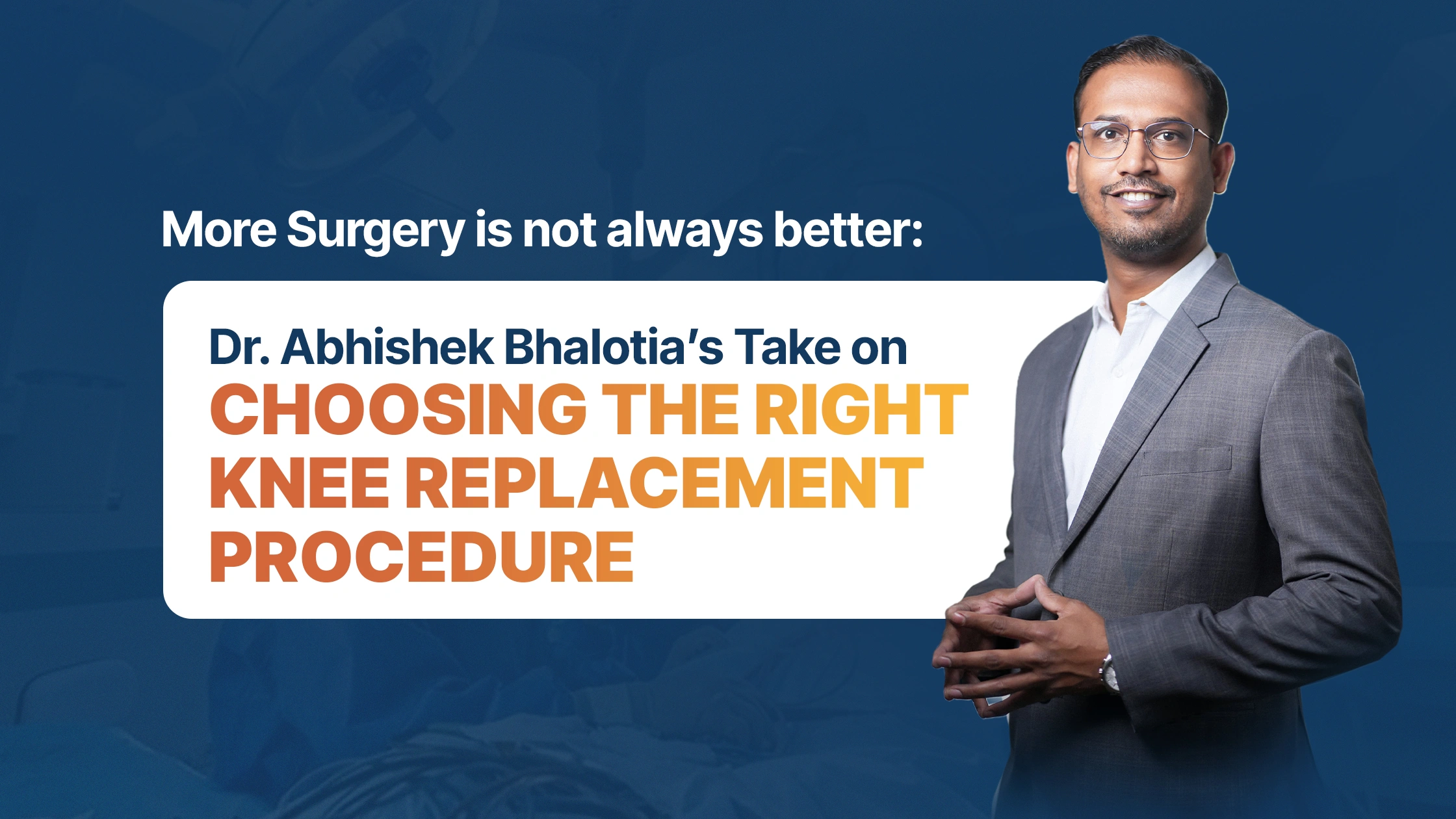
In medical decision-making, there is a common misconception that a bigger procedure automatically leads to better results. When it comes to knee replacement surgery, this assumption often pushes patients toward Total Knee Replacement, even when the knee damage may not require such an extensive intervention.
According to Dr. Abhishek Bhalotia, this approach can sometimes do more harm than good.
His philosophy is clear and consistent:
“The best knee replacement is not the one that replaces the most — it is the one that replaces exactly what is needed.”
This opinion has helped many patients navigate confusion caused by multiple opinions, internet research, and fear-driven decision-making.
Many patients believe that:
While these assumptions sound logical, they are not always medically accurate.
Dr. Bhalotia explains that knee arthritis behaves differently in different patients, and treatment should be proportional to the disease, not driven by fear or generalisation.

Before deciding on the extent of surgery, it is important to understand the options available.
Common knee replacement procedures include:
Each has its place. The key lies in choosing the right one for the right knee.
Dr. Abhishek Bhalotia often sees patients who have been advised Total Knee Replacement even though:
In such cases, he believes that replacing the entire knee may:
Partial Knee Replacement, when appropriate, avoids these issues by preserving what is healthy.
One of the core principles Dr. Bhalotia follows is proportionate intervention.
His decision-making is guided by:
This ensures that surgery is customised, not standardised.
Being balanced is central to Dr. Bhalotia’s approach. He is equally clear that Total Knee Replacement is absolutely necessary in many cases.
He recommends total replacement when:
In these situations, partial procedures may fail to provide long-term relief, making total knee replacement the more reliable option.
Patients often consult multiple doctors and receive different recommendations. This confusion usually arises because:
Dr. Bhalotia believes that patients deserve context, not just conclusions.
Another reason Dr. Bhalotia avoids unnecessary extensive surgery is recovery.
Larger surgeries often mean:
When a smaller, well-indicated procedure can achieve the same pain relief with faster recovery, choosing the larger option may not serve the patient well.
Dr. Abhishek Bhalotia’s approach helps patients:
Many patients seeking second opinions find clarity through this balanced, logic-driven evaluation.
More surgery does not always mean better results.
Better surgery means appropriate surgery.
By focusing on:
Dr. Abhishek Bhalotia ensures that patients receive the right level of surgical intervention — no more, no less.
For patients confused between partial and total knee replacement, this opinion offers reassurance:
the goal is not to replace the knee aggressively, but to restore movement intelligently.
Revolutionizing Joint Replacement with Robotic Precision
*This website is for providing general information only and should not be considered as medical advice or soliciting patients.
**An in-person consultation with the Doctor is adviced before practicing any remedies / recommendations mentioned on this website