

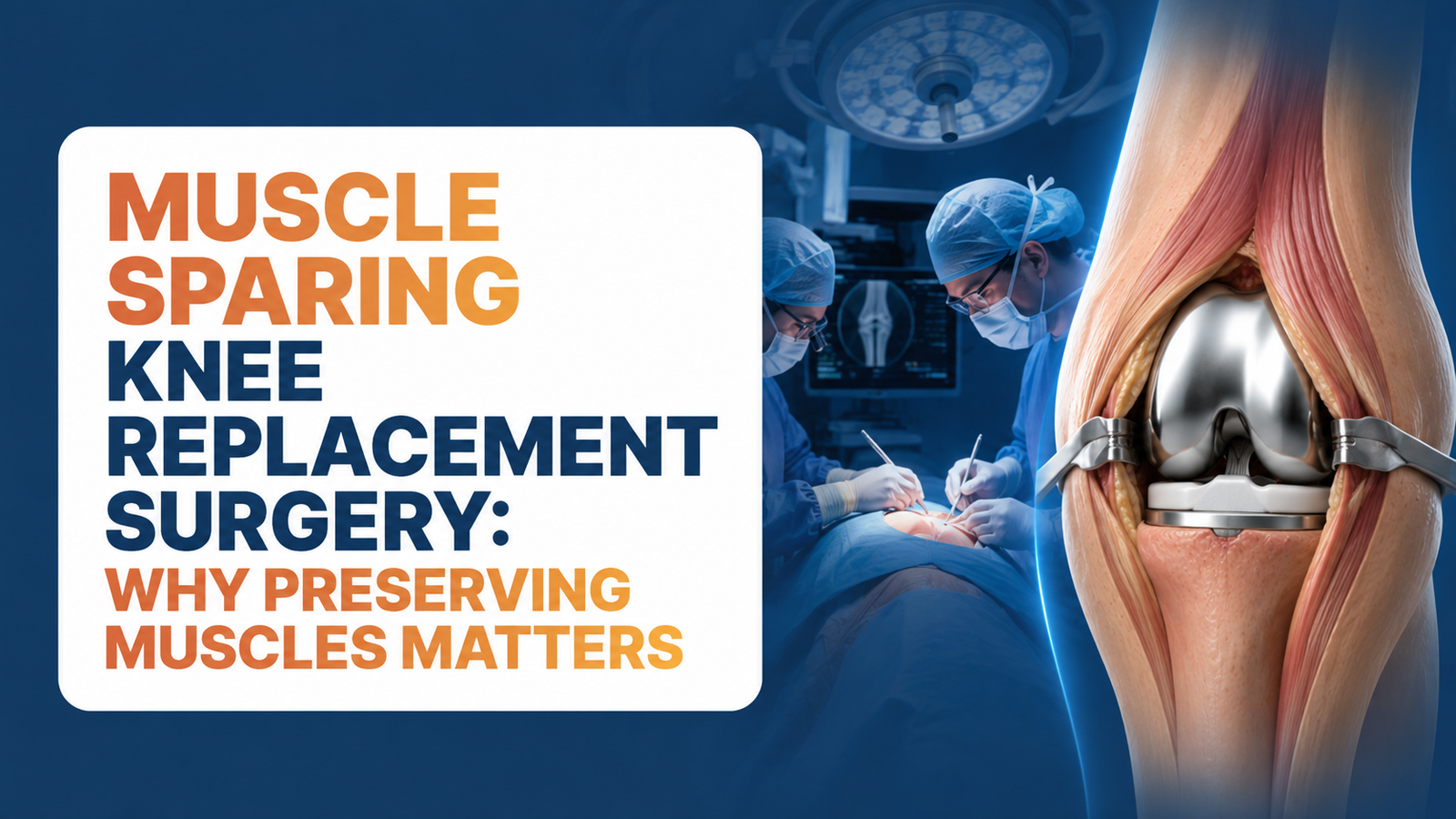
For decades, knee replacement surgery has transformed the lives of patients struggling with severe arthritis and chronic knee pain. As surgical techniques continue to evolve, modern orthopedic surgery is increasingly focused on achieving excellent results while minimizing disruption to the body’s natural structures.
One such advancement is the concept of Muscle sparing knee replacement surgery.
Patients often ask:
“If my knee is being replaced, why do the muscles matter?”
The answer is simple. While implants replace damaged joint surfaces, muscles play a critical role in movement, stability, strength, and recovery. Preserving these muscles whenever possible can have a meaningful impact on the overall surgical experience.
The knee does not function in isolation.
Every movement—whether walking, climbing stairs, standing up, or sitting down—depends on a coordinated effort between:
The quadriceps muscles at the front of the thigh are particularly important because they help control knee movement and provide stability during daily activities.
Modern surgical approaches aim to protect these structures as much as possible.
Muscle sparing knee replacement refers to surgical techniques designed to minimize unnecessary disruption of important muscle tissues during the procedure.
Rather than focusing solely on replacing the damaged joint, the approach emphasizes preserving the surrounding soft tissues whenever feasible.
The goal is to perform the surgery effectively while respecting the body’s natural anatomy.
Orthopedic surgery has evolved significantly over the years.
Today, surgeons recognize that successful outcomes depend not only on implant placement but also on how well the surrounding tissues recover after surgery.
Preserving muscles may contribute to:
One of the primary objectives is to reduce unnecessary injury to muscles and surrounding structures.
By limiting tissue disruption, the body may recover more efficiently after surgery.
When key muscle groups are preserved, patients may find it easier to participate in rehabilitation and early movement exercises.
Early mobilization is an important component of modern knee replacement recovery protocols.
Maintaining muscle integrity helps support strength and joint control during the recovery process.
Strong muscles contribute significantly to overall knee function.
Physiotherapy remains essential after any knee replacement.
However, preserving muscle tissue may help patients engage more effectively with rehabilitation programs and regain confidence in movement.
Modern orthopedic surgery increasingly emphasizes restoring function while respecting normal anatomy.
Muscle sparing techniques align with this philosophy by attempting to preserve as much healthy tissue as possible.
This is a common misconception.
The primary goal of knee replacement surgery remains the same:
A muscle sparing approach focuses on how the surgery is performed rather than simply reducing the size of the operation.
Precision and long-term outcomes always remain the priority.
Yes.
Many modern joint replacement centers combine muscle-preserving surgical principles with robotic-assisted technology.
Robotic systems can assist surgeons with:
Together, these advancements support a personalized and precision-driven approach to knee replacement surgery.
Not every patient requires the same surgical technique.
The most appropriate approach depends on factors such as:
A detailed evaluation helps determine the most suitable treatment plan for each individual.
While surgical technique is important, successful knee replacement depends on multiple factors working together:
No single factor determines success on its own.
The best outcomes occur when all aspects of care are aligned.
Muscle sparing knee replacement surgery reflects the ongoing evolution of orthopedic care toward techniques that prioritize both precision and tissue preservation.
By minimizing unnecessary muscle disruption while maintaining the goals of joint replacement, this approach aims to support smoother recovery, improved function, and a better overall patient experience.
For patients considering knee replacement surgery, understanding how modern techniques focus on preserving natural anatomy can provide valuable insight into today’s advances in joint replacement care.
Revolutionizing Joint Replacement with Robotic Precision
*This website is for providing general information only and should not be considered as medical advice or soliciting patients.
**An in-person consultation with the Doctor is adviced before practicing any remedies / recommendations mentioned on this website