

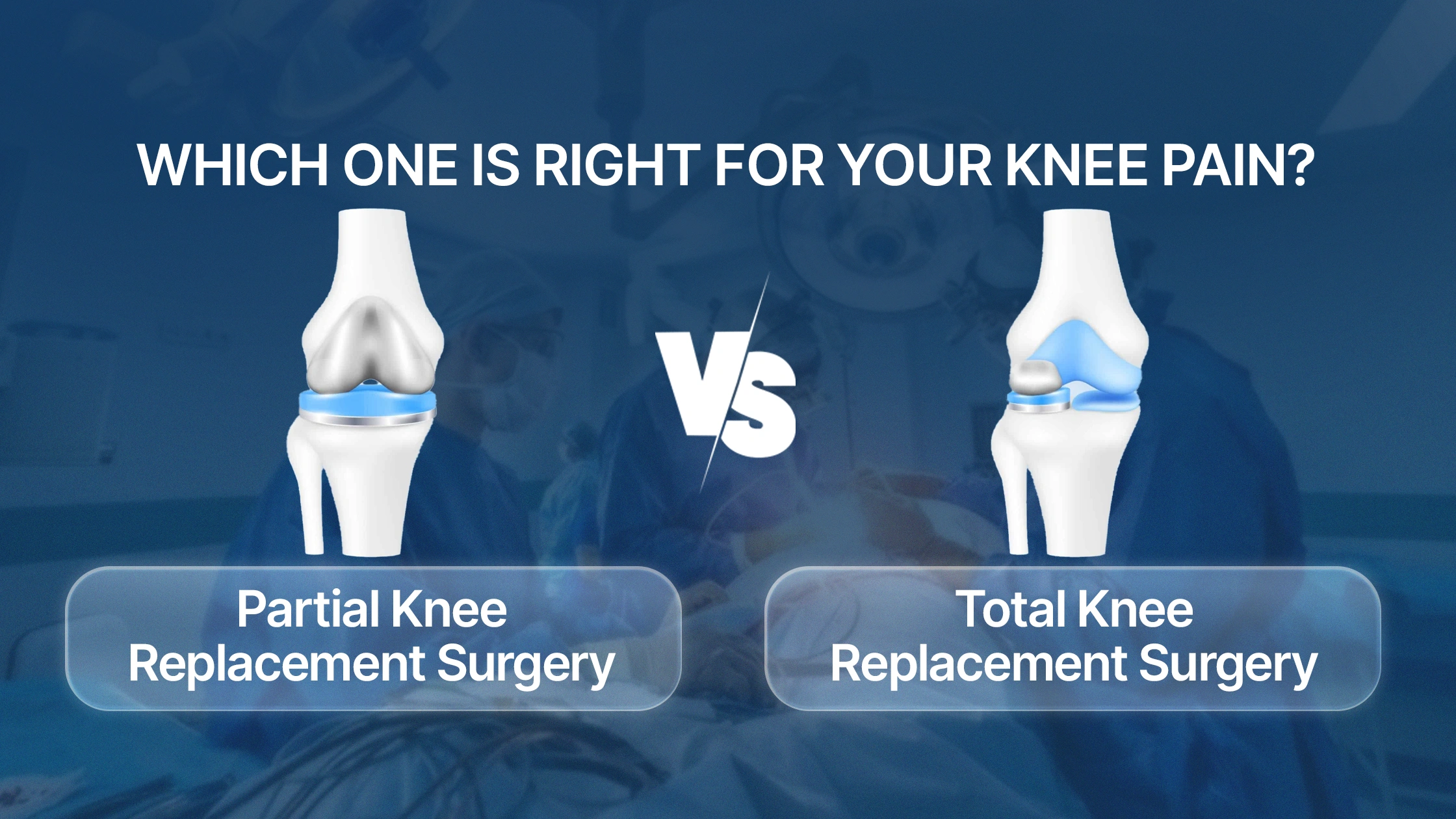
Knee pain can be confusing. Some patients are told they need surgery, others are advised to wait, and many hear different opinions about partial knee replacement versus total knee replacement. The truth is — there is no one-size-fits-all answer.
According to Dr. Abhishek Bhalotia, an expert in advanced knee replacement procedures, “The right surgery is not about replacing more — it’s about replacing only what is damaged.”
This blog explains the key differences between Partial Knee Replacement (PKR) and Total Knee Replacement (TKR), helping patients understand which option may be more suitable for their knee pain.
The knee is not a single solid joint. It is divided into three compartments:
Arthritis may affect just one compartment or all three. The extent of damage largely determines whether a partial or total knee replacement is required.

Partial Knee Replacement involves replacing only the damaged compartment of the knee while preserving healthy bone, cartilage, and ligaments.
Key characteristics:
This option works best when arthritis is localized, not widespread.
Total Knee Replacement replaces the entire knee joint, including all damaged compartments.
Key characteristics:
Total knee replacement is often recommended when the damage is extensive and affects overall knee stability.
Factor | Partial Knee Replacement | Total Knee Replacement |
Area replaced | Only damaged compartment | Entire knee joint |
Bone removal | Minimal | More extensive |
Ligaments | Preserved | Often sacrificed |
Recovery time | Faster | Relatively longer |
Knee movement | More natural | Stable but artificial |
Hospital stay | Usually shorter | Slightly longer |
Best suited for | Localized arthritis | Advanced arthritis |
Partial knee replacement is highly selective.
Patients may qualify if:
When done in the right patient, partial knee replacement can offer excellent long-term outcomes.
Total knee replacement may be a better option if:
In such cases, partial replacement may not provide lasting relief.
After Partial Knee Replacement:
After Total Knee Replacement:
Both surgeries are effective — the difference lies in extent of surgery and recovery speed.
Choosing between partial and total knee replacement is not based on age alone, nor on X-rays alone.
Dr. Abhishek Bhalotia follows a detailed evaluation process that includes:
Recommending partial knee replacement when it’s not suitable — or total replacement when partial would suffice — can impact long-term results.
Partial and Total Knee Replacement are both effective surgeries, but for different knee conditions.
The goal is not to replace more —
The goal is to replace what is necessary and preserve what is healthy.
As Dr. Abhishek Bhalotia often explains, “The best outcome comes from choosing the right surgery for the right knee — not the most aggressive one.”
Patients experiencing knee pain should seek expert evaluation, not assumptions, before deciding on surgery.

Revolutionizing Joint Replacement with Robotic Precision
*This website is for providing general information only and should not be considered as medical advice or soliciting patients.
**An in-person consultation with the Doctor is adviced before practicing any remedies / recommendations mentioned on this website