

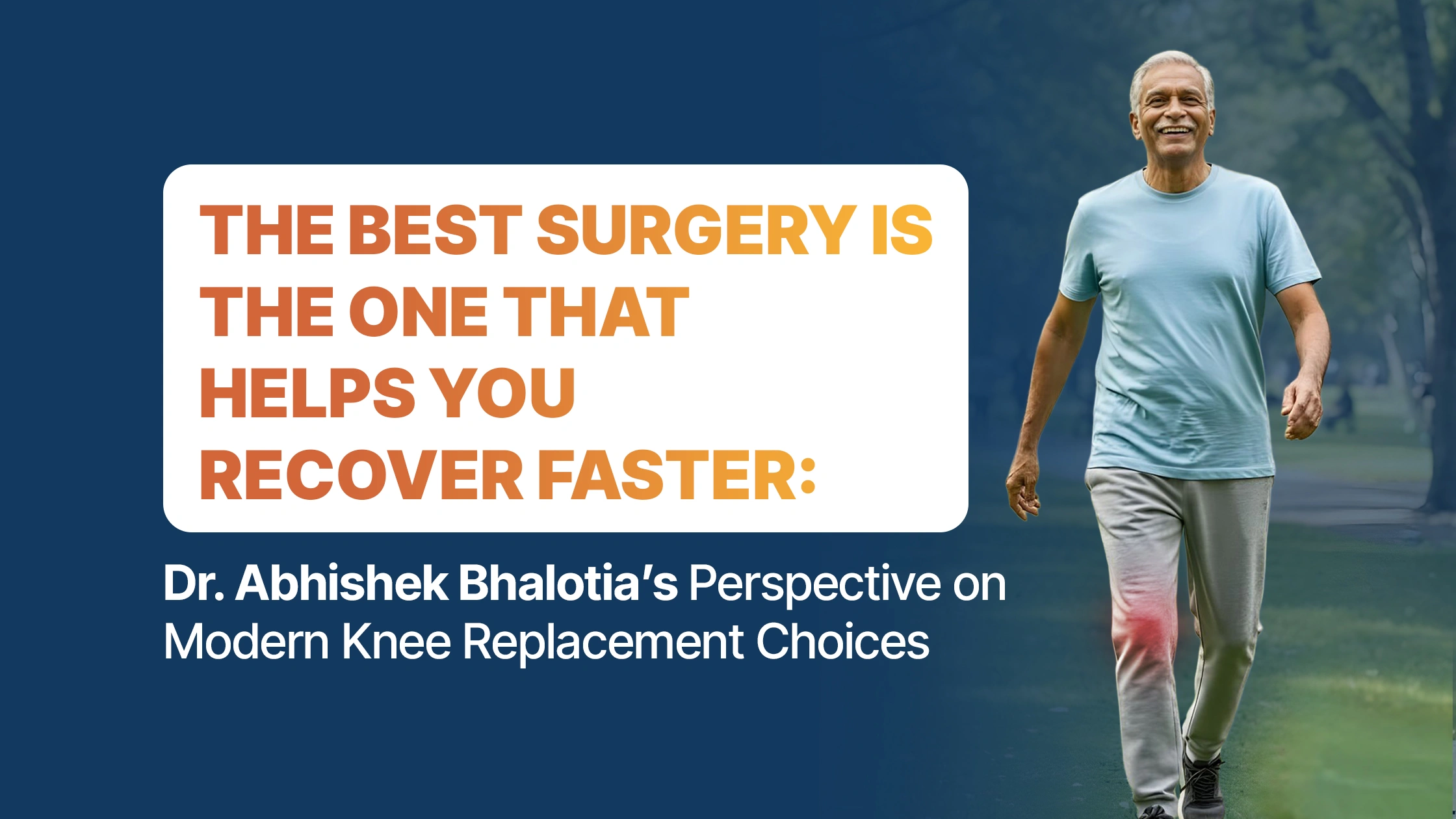
For most patients considering knee replacement surgery, the biggest concern is not the operation itself — it is life after surgery.
How soon will walking begin?
How painful will recovery be?
How dependent will one be on family members?
According to Dr. Abhishek Bhalotia, these are exactly the questions that should guide the choice of surgery.
His opinion is clear and consistent:
“The best knee replacement surgery is not the biggest or the most aggressive one — it is the one that helps the patient recover faster and return to normal life sooner.”
This recovery-first mindset defines how modern knee replacement decisions should be made.
Today’s patients are different from those of previous decades.
They are:
Dr. Bhalotia believes that knee replacement surgery should be planned not only around joint correction, but also around how the patient will live, move, and function after surgery.

Traditional thinking around knee replacement focused on:
Modern knee replacement, according to Dr. Bhalotia, focuses on:
This shift has led to the adoption of recovery-oriented surgical choices, including partial knee replacement and muscle-sparing techniques where appropriate.
Dr. Bhalotia often explains to patients that larger surgery means more healing.
Total Knee Replacement, while highly effective, involves:
In patients where arthritis is limited or localised, this level of surgery may:
In such cases, recovery may take longer than necessary.
Dr. Bhalotia’s approach to knee replacement focuses on choosing techniques that support early functional recovery.
These include:
The objective is not speed for the sake of speed —
it is safe, confident, and sustainable recovery.
According to Dr. Bhalotia, faster recovery is not just about timelines. It is about outcomes that matter in daily life.
Faster recovery translates into:
Patients who recover faster often feel more in control of their healing journey.
Dr. Bhalotia believes that every knee replacement decision should answer one key question:
“Which option will help this patient recover better?”
This involves evaluating:
A surgery that looks perfect on X-ray but delays functional recovery may not be the best choice for that patient.
Dr. Bhalotia is clear that recovery speed should not override medical necessity.
He prioritises total knee replacement when:
In these cases, a longer recovery is justified because it delivers durable, long-term relief.
The key is honesty — explaining to patients why recovery may take longer and why it is still the right decision.
Patients often receive conflicting advice:
Dr. Bhalotia’s recovery-focused opinion gives patients clarity by shifting the conversation from:
“Which surgery is bigger?”
to
“Which surgery helps me get back to life sooner?”
Knee replacement surgery has evolved — and so should the way decisions are made.
Dr. Abhishek Bhalotia’s perspective reflects modern orthopaedics:
Because in the end, the success of knee replacement is not measured in implants or incisions — it is measured in how quickly and confidently a patient returns to living their life.
Revolutionizing Joint Replacement with Robotic Precision
*This website is for providing general information only and should not be considered as medical advice or soliciting patients.
**An in-person consultation with the Doctor is adviced before practicing any remedies / recommendations mentioned on this website