

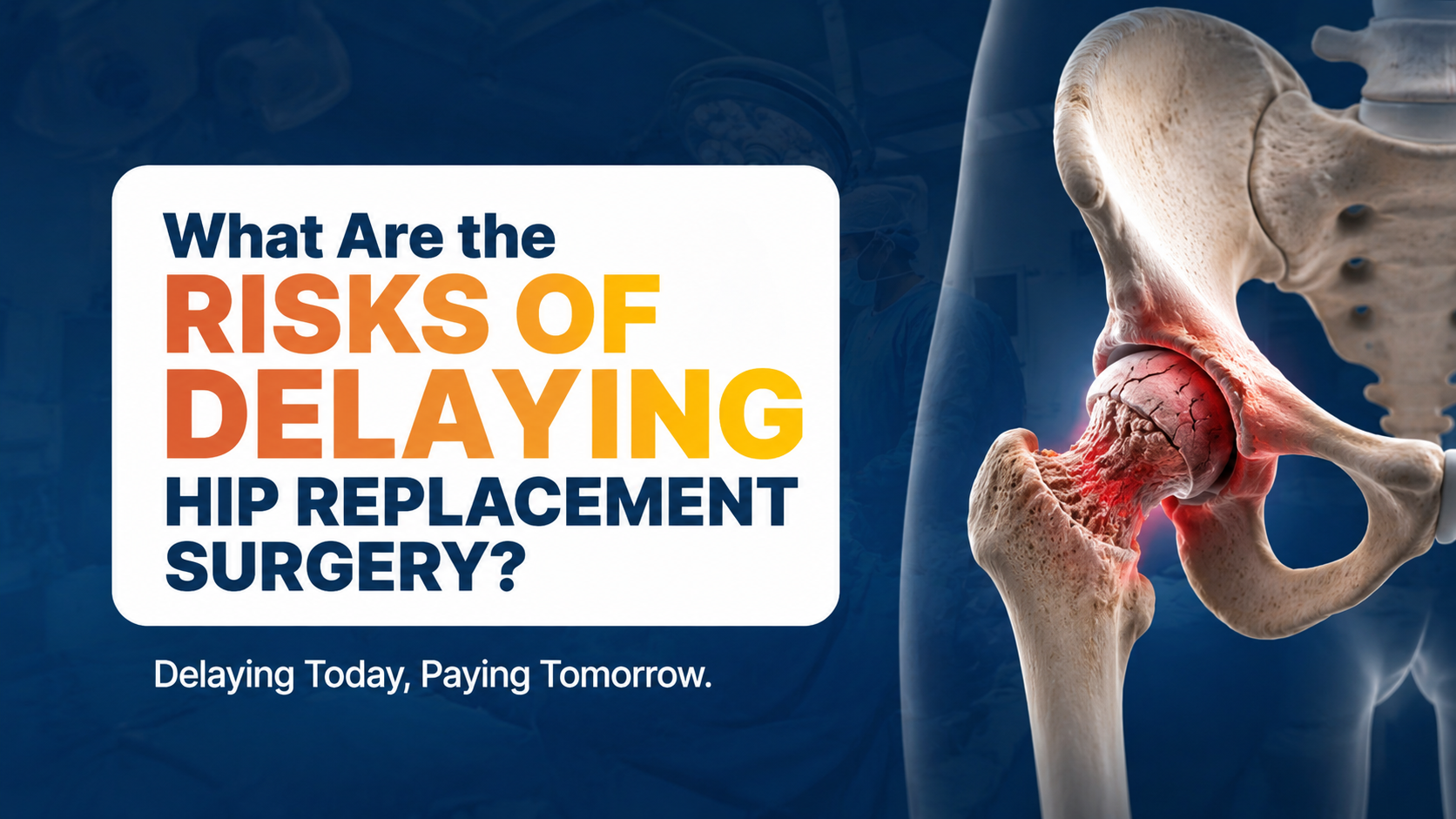
Hip pain is often ignored for months—or even years—by many patients. Some continue relying on painkillers, while others reduce their activity levels and gradually adapt to limited movement.
However, according to Dr. Abhishek Bhalotia, delaying Hip Replacement Surgery for too long can sometimes lead to worsening joint damage, reduced mobility, muscle weakness, and a more difficult recovery process.
Patients suffering from severe Hip Arthritis, Avascular Necrosis (AVN Hip), or chronic hip joint damage should understand how delaying treatment may affect both surgical outcomes and quality of life.
This article explains the major risks associated with delaying Total Hip Replacement Surgery (THR).
Hip Replacement Surgery is typically advised when:
Patients with severe:
may eventually require Total Hip Replacement Surgery to restore mobility and reduce pain.
According to Dr. Abhishek Bhalotia, the most common reasons include:
Unfortunately, delaying treatment often allows the joint damage to progress further.
The hip joint is a weight-bearing joint. As arthritis worsens:
Over time, patients may start avoiding movement completely because of pain.
This creates a cycle of:
Pain → Reduced movement → Weakness → More pain
One of the biggest risks is progressive joint destruction.
Severe Hip Arthritis and AVN Hip may lead to:
More advanced damage can sometimes make surgery technically more complex.
Patients with chronic hip pain often reduce walking and physical activity.
As a result:
Weak muscles may also slow down Hip Replacement Recovery after surgery.
As hip damage progresses, simple activities become challenging:
Many patients gradually lose confidence in movement and become dependent on family support.
Long-standing hip pain often changes walking mechanics.
Patients may begin:
This may increase stress on:
Delayed Hip Replacement Surgery can therefore affect multiple joints and posture over time.
Chronic pain affects more than physical movement.
Many patients experience:
Some patients stop travelling, exercising, or participating in daily routines due to persistent hip pain.
Patients often assume that delaying surgery will make them “mentally stronger” for the procedure.
In reality, delayed surgery may result in:
Patients who undergo surgery earlier, when medically appropriate may sometimes recover more smoothly because their muscles and mobility are better preserved.
In some cases, yes.
Early evaluation may allow treatment through:
However, once severe joint damage develops, Total Hip Replacement Surgery may become the most effective long-term solution.
Patients should consider evaluation if they experience:
✔ Persistent hip pain
✔ Difficulty walking
✔ Stiffness while getting up
✔ Reduced movement
✔ Pain affecting sleep
✔ Failure of conservative treatment
Early consultation does not automatically mean surgery—but it helps patients understand their options clearly.
Delaying Hip Replacement Surgery for too long may increase joint damage, muscle weakness, walking difficulty, and recovery challenges.
According to Dr. Abhishek Bhalotia, the goal is not to rush surgery unnecessarily—but also not to wait until mobility and quality of life are severely compromised.
Patients who seek timely evaluation often have:

Revolutionizing Joint Replacement with Robotic Precision
*This website is for providing general information only and should not be considered as medical advice or soliciting patients.
**An in-person consultation with the Doctor is adviced before practicing any remedies / recommendations mentioned on this website