

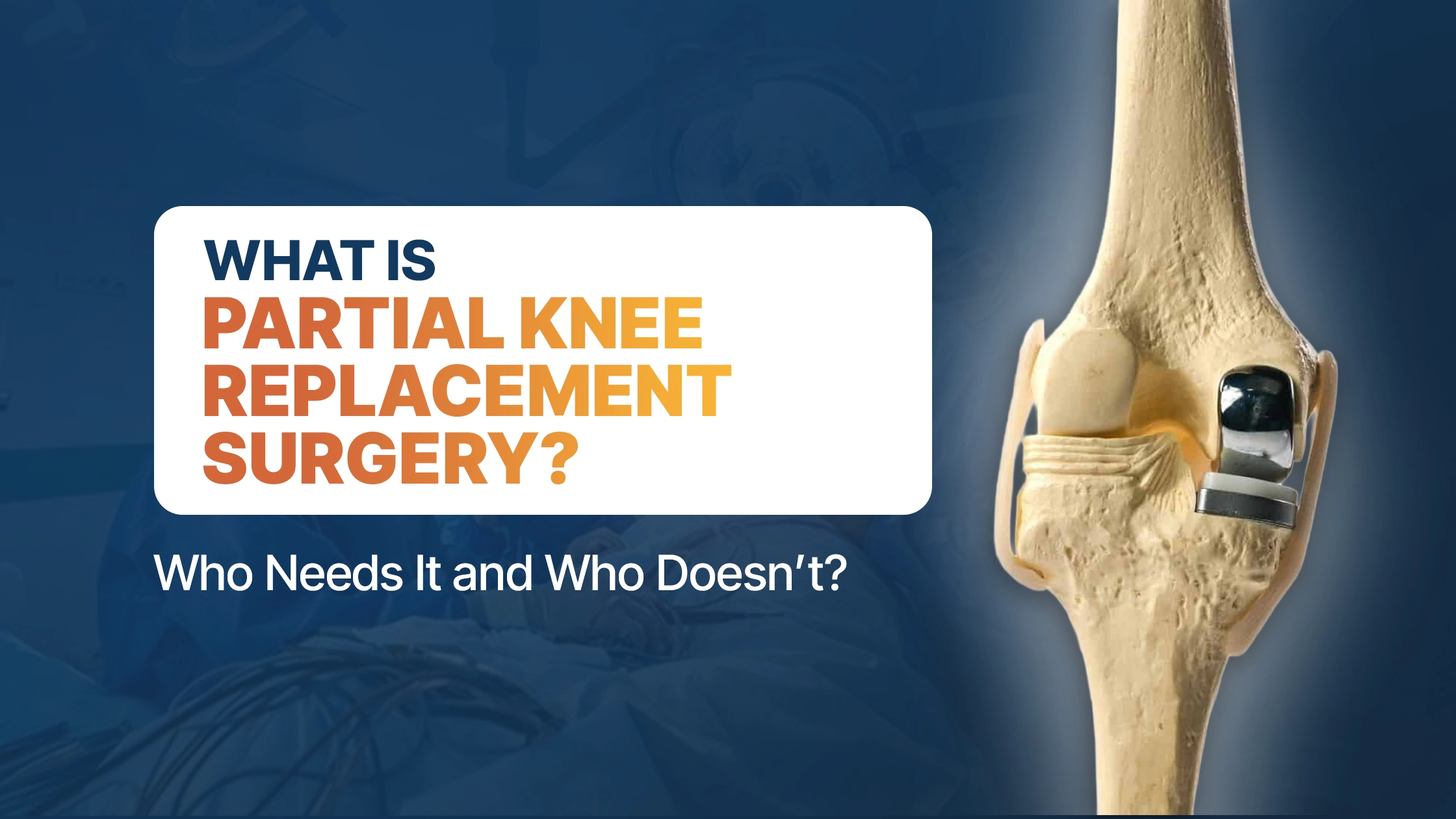
Knee pain does not always mean that the entire knee joint is damaged. In many patients, arthritis affects only a specific portion of the knee, not the whole joint. Yet, due to lack of awareness, many people assume that Total Knee Replacement is the only surgical solution.
This is where Partial Knee Replacement Surgery becomes an important and often overlooked option.
According to Dr. Abhishek Bhalotia, a specialist in advanced knee replacement procedures, “Not every painful knee needs a full replacement. In the right patient, partial knee replacement can deliver excellent pain relief with faster recovery and more natural movement.”
This blog explains what Partial Knee Replacement is, who is an ideal candidate, and who may not benefit from it — helping patients make informed decisions about their knee health.
Partial Knee Replacement (PKR) is a surgical procedure in which only the damaged compartment of the knee joint is replaced, while the healthy parts of the knee are preserved.
The knee has three compartments:
If arthritis is limited to just one compartment, a partial knee replacement may be sufficient.
In simple terms:
This approach helps retain much of the knee’s natural structure, ligaments, and movement.

Partial knee replacement is becoming increasingly popular because it offers several advantages when used in the right patient.
Key benefits include:
Patients often report that the knee feels more “normal” after a partial replacement.
Partial knee replacement is not suitable for everyone, but it can be an excellent option for carefully selected patients.
You may be a good candidate if:
Dr. Abhishek Bhalotia emphasizes that proper diagnosis and imaging are crucial before recommending partial knee replacement.
While partial knee replacement offers many benefits, it is not the right solution for every knee problem.
Partial knee replacement may not be ideal if:
In such cases, Total Knee Replacement may provide more predictable and long-term relief.
Aspect | Partial Knee Replacement | Total Knee Replacement |
Area replaced | Only damaged part | Entire knee joint |
Bone removal | Minimal | More extensive |
Recovery | Faster | Relatively longer |
Knee feel | More natural | Artificial but stable |
Best for | Localized arthritis | Advanced arthritis |
One of the biggest advantages of partial knee replacement is the speed of recovery.
Most patients can expect:
Because muscles and healthy joint structures are preserved, patients often feel stronger and more stable during recovery.
Partial knee replacement requires high surgical precision. Since only a portion of the joint is replaced, implant positioning, alignment, and ligament balance become extremely important.
Dr. Abhishek Bhalotia follows a patient-specific evaluation approach, ensuring that:
Choosing the right surgeon is just as important as choosing the right procedure.
Partial Knee Replacement is a powerful but selective solution. It is not a shortcut, nor is it suitable for everyone. But in the right patient, it can offer:
The key lies in correct diagnosis, honest assessment, and expert surgical judgment.
As Dr. Abhishek Bhalotia often highlights, “The best knee replacement is the one that replaces only what is damaged — and preserves everything else.”
Revolutionizing Joint Replacement with Robotic Precision
*This website is for providing general information only and should not be considered as medical advice or soliciting patients.
**An in-person consultation with the Doctor is adviced before practicing any remedies / recommendations mentioned on this website